 Skip to content

Introduction: The PhD Holidays I Should Have Taken
Ciao a tutti, Giuseppe here! Today I’m back with another Retrospective (“lessons I learnt the hard way”) from my PhD years. It’s about something I stubbornly ignored at the time — and paid the price for. By sharing it, I hope some of you who are walking the same road can avoid falling into the same trap.
If I could travel back in time and give my younger self one wise piece of advice, it would be this: don’t study Biology!… No I am kidding, it would be: use every single one of your PhD holidays.
Back then, I believed productivity was a simple formula: more hours in the lab = faster progress = quicker graduation. Holidays, weekends, even evenings off felt like distractions. My mantra was: “First finish the PhD, then you can rest.”
Spoiler: that strategy didn’t earn me a faster PhD. What it did earn me was exhaustion, stress, and eventually, burnout.
That’s why today’s retrospective is dedicated to a truth I wish I’d embraced sooner: rest isn’t wasted time — it’s the fuel that keeps you moving forward.

My PhD Story: How I Worked Myself Into the Ground
Before I dive into my story, let me just highlight the absurdity of it all. I am not the kind of person who lives for work. Don’t get me wrong, work matters — but free time, traveling, holidays, visiting family, and just living life have always been the things that recharge me. Those are the experiences that actually make me feel alive.
And yet… during my PhD, I ignored all of that. I consistently prioritized work over holidays, even though deep down I knew better. If you’re thinking this sounds a bit masochistic, well… you’re not wrong. But hey, I was a biologist doing a PhD — what did you expect?
Alright, let’s rewind to those years.
The Panic Years: When Nothing Worked
My PhD was a five-year investigation into the molecular mechanisms of aging. Coincidentally, I also conducted an unplanned parallel study on graduate student decomposition — the correlation was (unfortunately) remarkably strong.
The first couple of years were painfully unproductive. My experiments didn’t work, my projects weren’t solid, and with every month that passed without results, I sank deeper into the quicksand of academia. (For the uninitiated: “quicksand” here means you can’t graduate without publications, and you can’t publish without data. See the problem?)

The longer I stayed stuck, the more desperate I became. Instead of stepping back to re-think my approach, that mounting pressure triggered my worst instincts. I convinced myself that the solution was simple: work more hours, take fewer breaks, and throw sheer effort at the problem until things improved.
The Fatal Logic: Work Harder = Graduate Faster
So, I did what most stressed PhD students do: I doubled down. I stretched my days, filled evenings and weekends in the lab, and convinced myself that more hours = more data = faster graduation.
The idea of “seeing the end” became my life priority. Holidays? Optional. Breaks? An obstacle. I created this twisted equation in my head:
First publish → then graduate → THEN enjoy life.
Very healthy, right? I should probably get royalties for pioneering the “burn out to break through” methodology, 100% success rate!
What Else Kept Me in the Lab: The Hidden Barriers
But this workaholic mentality wasn’t the only culprit. Looking back, I realize there were other practical barriers that made taking breaks feel complicated:
Stem cells Ate My Vacation Plans
And to make my life harder, I worked with stem cells and worms — not exactly the most cooperative colleagues. These creatures needed care every single day, which meant I needed to be in the lab almost every single day.

Every potential vacation required a complex ritual: freeze everything, cross your fingers, hope nothing dies while you’re gone. And when I came back? The restart process could take weeks. So I’d calculate: “Is this week off worth losing a month of progress?” The answer was usually no.
Reading this now, I realize how bizarre it sounds: my life choices dictated by microscopic worms. Apparently, I owed serious karmic debt to the worm community from a previous life.
The Unspoken Expectations
Another reason was concern of my boss’s reaction. He never explicitly told me not to take holidays, but in academia, sometimes silence is louder than words. Add a dash of passive-aggressive vibes, and suddenly asking for a vacation felt like asking for a kidney donation.
To be clear, not every PI is against breaks, but some really do see PhD holidays as a lack of commitment. I should have advocated for myself better. I didn’t, and that’s on me.

The Reality of Taking Breaks During a PhD
To be fair, I didn’t completely avoid PhD holidays. But they became rare exceptions, mostly trips home to visit family. Instead of using all my allocated leave, I typically took just two breaks per year: one in summer and one at Christmas. That meant at least a third of my vacation days went unused every year.
Looking back, it makes no sense. I threw away holidays I was owed and desperately needed, as if exhaustion was a badge of honor. I convinced myself it was noble and a sign of dedication. It wasn’t. It was stupidity.
And even when I finally managed to escape, I couldn’t fully switch off. My inbox kept dragging me back — one email was enough to pull me from “holiday mode” straight back into “lab panic mode.” So even my breaks weren’t truly breaks.
Academic Culture and the Guilt of Taking PhD Holidays
And the worst part? I felt guilty every time I stepped away from the lab. (Don’t tell me you haven’t felt this too — I know some of you are nodding right now.)
The Academic culture doesn’t help. In academia, overwork is often worn like a badge of honor. PhD students would casually brag about who stayed the latest, like some twisted version of Olympic exhaustion. “Oh, you left at midnight? Amateur. I saw the sunrise from my desk chair.”
Supervisors would drop comments about weekend experiments as if they were the most natural thing in the world. Taking a vacation almost felt like confessing you weren’t serious about science.
When that’s the atmosphere, you adapt — sometimes without even realizing it. Suddenly, you’re feeling guilty for doing things that should be basic human rights: working reasonable hours, taking weekends off, visiting family for more than three days in a row. Half my actual holidays were spent feeling like I should be somewhere else.

The Inevitable Crash: When Burnout Finally Caught Up
Of course, this lifestyle wasn’t sustainable. As time passed, I grew more and more exhausted. I was running on pure stubbornness and the delusion that “just one more experiment” would solve everything. My body was writing checks my nervous system couldn’t cash.
Here’s the paradox: I thought working more hours without breaks would speed up my PhD. Instead, it slowed me down. I poured energy into unproductive hours, which meant I achieved less with more effort. Eventually, I hit burnout. And once you’re there, no amount of late nights will save you — you have to stop and recover.
Not taking my PhD holidays wasn’t the only reason I burned out, but it was a big contributor. And it was completely avoidable.
That’s when it finally clicked: Breaks shouldn’t feel like escaping from life. They should be part of life — the part that makes everything else sustainable.
What I Learned After Escaping Academia
Eventually, I recovered enough to push through, finish my PhD, and even publish. On paper, I succeeded. But my strategy? Completely wrong.

Ironically, the biggest “break” I took wasn’t planned — it was when I finished my dissertation and suddenly became unemployed. Honestly? It felt like stepping out of jail after five years. Fresh air. Freedom. A life. And the sudden, terrifying realization that I had no idea what normal people did with their evenings.
Ironically, the biggest “break” I took wasn’t planned — it was when I finished my dissertation and suddenly became unemployed. Honestly? It felt like stepping out of jail after five years. Fresh air. Freedom. A life. And the sudden, terrifying realization that I had no idea what normal people did with their evenings.
That strange in-between stage taught me something: I didn’t just need a holiday, I needed a healthier system. The real turning point came when I moved into industry, where I finally saw how different — and healthier — things could be.
👉 (Curious about another retrospective lesson from my PhD? Check this out: Science Career Advice for Biologists: Explore Early, Succeed Faster.)
How Industry Changed My Perspective on Breaks
When I moved into industry as a Field Application Specialist (FAS), I quickly discovered how different things could be — at least in the company I joined. Here, people were encouraged to take all their holidays. Bosses even reminded us to book time off. The first time my manager told me, “Don’t forget to schedule your vacation,” I honestly looked around for hidden cameras.
And the amazing part? Nobody felt guilty about it. Quite the opposite — taking holidays was seen as smart management. A well-rested employee is more creative, reliable, and productive than someone who’s running on fumes. From the company’s perspective, burnout isn’t just bad for you, it’s bad for business.
That mentality completely rewired me. I started taking every single vacation day — and I used them not just to enjoy life but also to recharge properly. Only then did I realize how essential breaks really are. After a true holiday (the kind where you actually disconnect), I came back sharper, calmer, and yes, way more productive.
Sure, the first couple of days back were always rough (post-holiday blues are very real — especially when your inbox has tripled). But within a week, I could feel the difference in focus and energy.
That left me wondering: was this just me, or PhD holidays truly make a measurable difference? Being a scientist, I couldn’t resist digging into the research. And guess what? The science is clear: taking holidays really does matter.
👉 (PS: If you’re also debating whether to stay in academia or jump to industry, you might like my post: “What to Do After PhD: Academia vs Industry Career Path.” Or if you’re still exploring options, check out: “What Can You Do with a PhD in Biology? Discover Exciting Career Paths”)
What the Research Actually Says
Yes, there are scientific studies about the importance of holidays — because what’s better than that, to passive-aggressively tell your boss you need holidays?!
Vacations Boost Well-being
A 2025 meta-analysis of 32 studies found that holidays significantly improve employee well-being — especially when people truly disconnect from work and engage in active or social leisure (translation: go hiking, meet friends, play with your nephew, don’t just check your inbox from the beach).

Take that, Academia! Turns out that “wasting time” is actually an evidence-based productivity strategy.
Health and Productivity Improve
Vacations aren’t just mood boosters — they’re full-blown health interventions. A recent study links regular holidays to reduced burnout, better mental health, and even a lower risk of cardiovascular disease. In fact, taking vacation has been directly associated with lower cardiovascular mortality. Translation: those beach days may literally save your life.
Your body literally changes when you take time off:
- You sleep more — about 20 extra minutes a night, and the effect lingers for weeks.
- You move more — from extra walks to bursts of real exercise.
- You sit less — almost half an hour less per day.
True disconnection improves sleep, reduces stress, and lifts well-being for weeks afterward — in some cases up to 45 days. And for professions under chronic overload, the effect is huge: US physicians taking 3+ weeks off per year showed a much lower risk of burnout.
The Catch: Working During Vacation Cancels the Benefits
Of course, there’s a catch. If you keep “just quickly checking” emails or working on manuscripts during holidays, most of these benefits evaporate. Studies show that working on vacation keeps your body in a state of prolonged stress activation, preventing real recovery.
Among physicians, doing patient-related work for 30 minutes or more per vacation day was linked with much higher odds of burnout. Push that to over 90 minutes, and the burnout risk nearly doubles. Emotional exhaustion goes up, professional fulfillment goes down.
And when people don’t disconnect, the post-vacation bounce can even backfire: sedentary time increases and activity levels drop as the weight of accumulated tasks crushes you back at work.
Yes, that means checking your emails “just in case” is basically the same as not taking a holiday at all.
Creativity Rebounds After Time Away
One longitudinal study looked at creativity levels before and after vacations. The pattern was fascinating: right after coming back, creativity actually dipped. (That’s the “post-holiday blues” phase when you’re Googling ‘how to quit academia and open a bakery in Tuscany’.)
But about two weeks later, creativity levels shot up significantly. In other words, holidays don’t just refresh your brain — they plant seeds that bloom into better ideas once you’re back.
Academia is Especially at Risk
Burnout isn’t a rare exception in academia — it’s baked into the system. Surveys show that PhD students are particularly vulnerable. In one study of Spanish doctoral candidates, more than 10% were officially classified as burned out. Contributing factors? Poor supervision, chronic overwork, and the constant feeling of being behind.
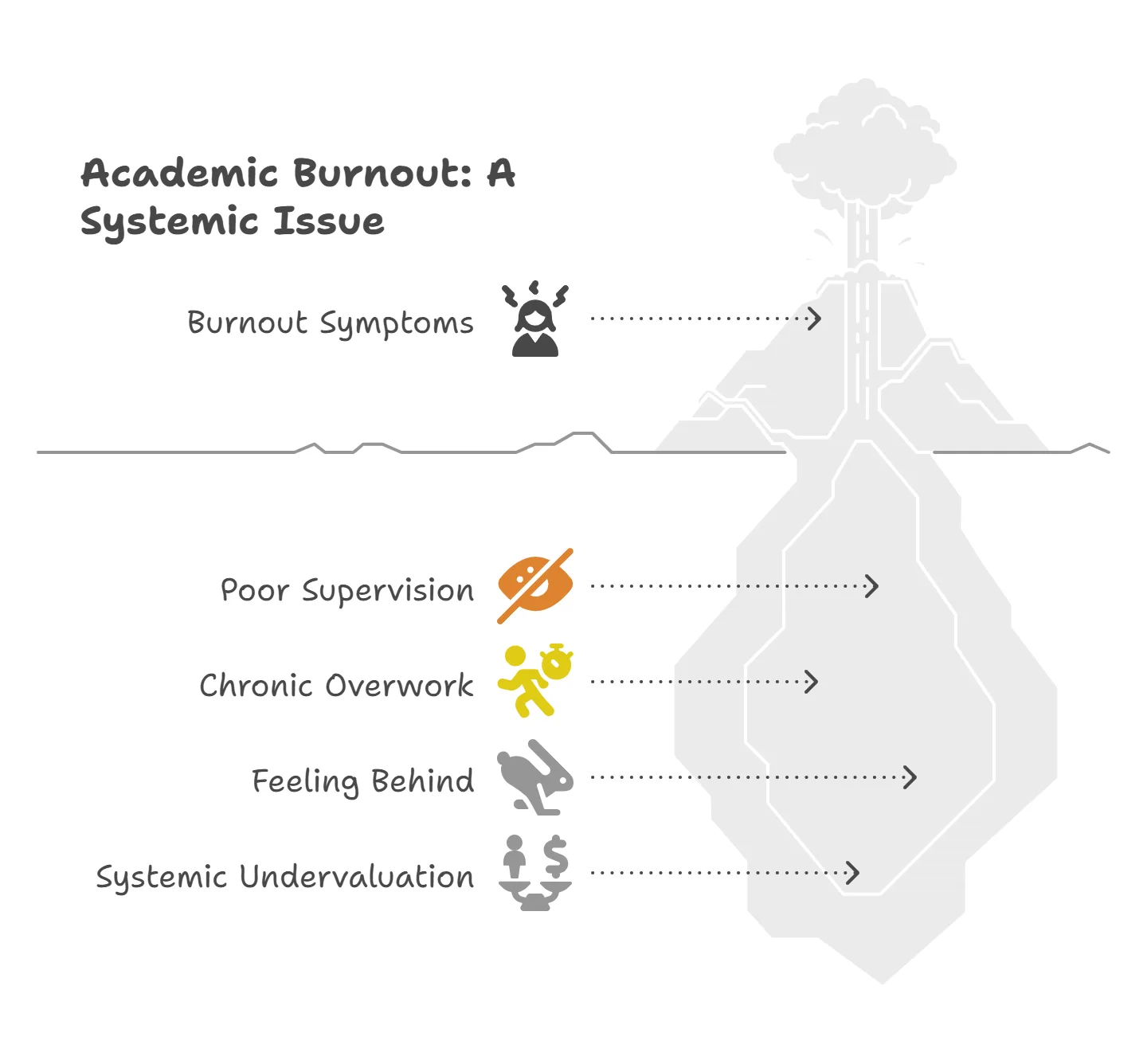
So, what happened to me wasn’t a personal failure or bad luck. It was a predictable outcome of a system that undervalues rest and glorifies overwork.
But that raises a deeper question: why are humans so sensitive to overwork in the first place, and why do breaks matter so much?
The Myth of Constant Productivity
I recently read a book called Slow Productivity by Cal Newport. The main argument? Working more hours doesn’t necessarily mean getting more done — especially in jobs like research, where brainpower, not brute force, is the limiting factor.
One of the most interesting ideas in the book is about human work cycles and seasonality.
The short version: humans are not designed for constant, flat-out productivity. Our bodies and brains run on rhythms — daily, monthly, seasonal. Ignoring these rhythms is like ignoring gravity: you can try, but eventually you’ll hit the floor.
Work Has Always Been Seasonal
In this interesting article, Cal Newport nicely describes this concept: human beings have always worked in cycles, alternating between bursts of intensity and periods of rest.
- Hunter-gatherers worked hard in bursts — maybe twenty hours a week hunting, another twenty preparing food — and then had plenty of time for rest and leisure. Hunt in the morning, eat in the evening. Work was basically a part-time gig.
- Farmers worked like crazy during planting and harvest, but winter brought a natural slowdown.
In other words, intense work was always followed by recovery. Compare that to today’s “constant grind” model — 40+ hours, every week, all year, with little room for meaningful breaks. It’s a modern invention, and our biology hasn’t caught up.
Why Modern Jobs Burn Us Out
Here’s where things went wrong. Modern jobs ignore cycles completely. Instead of alternating between sprints and recovery, we’re expected to deliver at the same medium-high level every single day. It’s like being told to run a marathon at near-sprint pace — you’ll manage for a while, but eventually you’ll collapse on the pavement.
Add to this another mismatch: feedback. For most of history, effort and reward were tightly linked. You tracked an antelope, you got dinner. Today, in research or knowledge work, the payoff can take months or years (if that grant ever comes through). Without quick wins, fatigue hits harder, and respecting natural cycles becomes even more important.
A Lesson for PhDs (and the Rest of Us)
For PhDs — and, honestly, most knowledge workers — the takeaway is clear: you can’t sprint all year. I tried during my PhD, and let’s just say it didn’t end well (unless you count burnout and digestive issues as “results”).
Instead, productivity works better when you lean into cycles: periods of deep, heavy work balanced with lighter phases and real recovery. Nature grows in seasons — and so do we.

So, if you find yourself in a similar situation to mine, what should you do?
What I Would Do Differently: A Practical Checklist
If I could send a message back in time to my PhD self, it would include this checklist. (Though honestly, lottery numbers would probably be more life-changing.)
1. Use all your holidays
Don’t leave PhD holidays unused. Vacation days are your right, and they’re not a luxury — they’re fuel. Breaks recharge your brain so you actually work better afterwards.
These days, when I feel tired or overwhelmed at work, I plan a proper vacation. I switch off, step away, and when I return, I’m fresher, calmer, and much more effective.
Don’t make my mistake: skipping holidays doesn’t make you heroic, it just makes you burned out.
👉 Curious about my current role? Check out this post: Field Application Specialist: A Smart, Rewarding Role for Biologists.
2. Detach completely
Remember that study I mentioned earlier? The benefits of holidays vanish if you keep working. Detaching fully is the secret sauce.
Today, I have two phones: one for work, one for personal use. On holiday, my work phone stays in a drawer. During my PhD, I only had one phone, so work emails would sneak in, drag me back into the spiral, and ruin the break.

If you can, create a clear boundary: a second SIM, a dedicated email app, or just delete the work inbox from your phone when you’re off. Real disconnection is what allows real recovery.
3. Don’t be scared of your supervisor
I know, easier said than done. One of the reasons I skipped holidays was the fear my boss wouldn’t approve. Sometimes this fear is all in your head — your supervisor might not even care. Other times… well, let’s just say some PIs would love to squeeze you like a lemon until nothing’s left.
Either way, you still need breaks. Your supervisor cannot legally forbid you from taking them. And if they do get annoyed? They’ll forget about it in a week. Prioritizing your mental health isn’t selfish — it’s survival.
4. Build micro-breaks
During intense phases, I often worked all day without stopping. What a terrible idea! Short breaks during the day keep you sane and prevent the “lab zombie” effect.
Respect your natural rhythm. When that circasemidian dip hits (usually early afternoon), don’t fight it with a gallon of coffee. Take a walk, grab a snack, chat with a colleague, or just stare at that tree (It’s been there longer than your PhD and seems remarkably stress-free about it, and unlike your data, it grows at a reasonable, predictable pace).
Small pauses can reset your brain. Science backs this up. A 2022 meta-analysis found that micro-breaks of just a few minutes boost well-being (less fatigue, more energy) and improve performance on tasks that require sustained focus.
That said, micro-breaks aren’t the same as true time off. Because they happen in the work context — surrounded by lab benches, inboxes, and colleagues — they don’t provide the full psychological detachment of evenings, weekends, or vacations. Still, they’re an easy, daily investment in not burning out before your next real holiday.
5. Think in seasons
As we discussed earlier, humans aren’t built for constant, flat productivity. We work better in cycles: periods of high intensity followed by periods of recovery.
Academia actually has this built in — thesis deadlines, conferences, grant submissions. These are intense sprints. But the problem (at least in my case) was that I never allowed myself the slower phases afterwards.
So here’s the mindset shift: accept that some months will be busier, and others quieter. Productivity is seasonal, not flat. And that’s not laziness — that’s how humans are wired.

Even if I had implemented just half of these during my PhD, I’m convinced my years would have been healthier, happier, and probably more productive too.
Final Thoughts: Your Brain Needs Holidays
If you’re in the middle of your thesis, I get it. The pressure to push harder, work longer, and sacrifice every break is enormous. But here’s the truth I wish I had learned sooner: rest is not the enemy of progress — it’s the foundation of it.
Science is clear. We need breaks. Without them, your productivity drops, your creativity shrinks, and eventually your health pays the price. Skipping rest doesn’t make you a better researcher; it just makes you a more exhausted one.
So why do so many of us feel guilty about taking time off? The culprit is overwork culture — a mindset that has normalized unhealthy schedules and made rest look like weakness.
Academia seems particularly resistant to changing this mindset and clings with the myth that nonstop grind equals serious science. Meanwhile, many industries have embraced a radical idea: functional humans do better work than caffeine-fueled zombies.
I only learned this lesson after leaving. Suddenly vacations weren’t a shameful indulgence — they were encouraged. That shift rewired how I think about work and health. I wish I had treated my brain less like a machine to be run nonstop, and more like a field — with seasons of planting, and seasons of rest.

Systemic change will take time. But we don’t need to wait for it. Start with yourself: take the holiday, use the vacation days, disconnect fully. No emails. No guilt. No half-measures.
Because here’s the thing: you can replace lost data, you can repeat an experiment, but you can’t replace your health. Protect it now, and your future self (and your thesis) will thank you.
What’s Your Next Move? Let’s Talk!
So, what do you think? Have you ever felt that same way about taking holidays during your PhD or academic work? Or maybe you’re in industry now and noticed the difference? I’d love to hear your story — and what you’d do differently. Share it in the comments!
Let’s keep the conversation going:
- 💬 Drop a comment below—Do you feel guilty about taking breaks? Or do you have a strategy that helps you actually rest without guilt? Your tips might help someone else in the same boat.
- 🔄 Share this post—(Buttons below 👇) Know a PhD student or academic friend burning themselves out? Send this their way — sometimes we need permission from others to take that break.
- 📩 Subscribe to the Curiosity Bloom newsletter—You’ll get post updates about topics such as career insights, AI trends, and behind-the-scenes lessons from the life science world, with a pinch of humor, straight to your inbox.
- 🚀 Curious for more?—Check out the rest of the blog for more stories, career tips, and insights on life sciences, product management, and how AI is shaking things up. Plenty more to explore!
And of course, Grazie for reading! 🌟
FAQ: PhD Holidays and Burnout
How many vacation days do PhD students usually get?
This depends a lot on the country and institution. In Europe, PhD students often have the same vacation entitlement as employees (20–30 days per year). In the US, it can be much less formal and depends on the PI or department. Always check your contract or HR policies.
What if my supervisor discourages me from taking holidays?
Your contract likely protects your right to take them. If you feel uncomfortable, start with shorter breaks and communicate clearly about your plans. If things get tricky, HR, graduate offices, or union reps can help. Remember: holidays are a right, not a luxury.
What if I feel anxious when I’m not working?
This is common in academia. Try setting clear boundaries (e.g., turning off email notifications), planning holidays around natural project pauses, and using mindfulness or journaling to calm “work guilt.” If anxiety is overwhelming, it’s worth seeking professional support.
Do industry scientists also face burnout?
Yes, but many companies actively prevent it by encouraging vacation use and offering wellness programs. The culture is usually more structured around work-life balance compared to academia.
Is it “career damaging” to take all my PhD holidays?
Absolutely not. In fact, protecting your health makes you more reliable and creative in the long run. No paper or experiment is worth your well-being. And trust me: no one will praise you years later for the holidays you didn’t take.
