 Skip to content

Introduction: From Lab Rat to Globe-Trotter
Ciao a tutti, Giuseppe here!
I have a question for you. Have you ever found yourself daydreaming about a career that combines your love for science with the excitement of travel? If so, buckle up, because I’m going to take you on a journey through a career path that’s been my ticket to combining science, travel, and, naturally, the chance to eat food specialties through every city and country I visit.
And the cherry on top? Getting to help others along the way. Welcome to the life of a Field Application Specialist (aka Field Application Scientist or simply FAS).

From PhD to Field Application Specialist: My Career Switch
Let me give you a bit more background about myself. I’m a molecular biologist by training, with a PhD in age-related neurodegenerative diseases. Pretty intense stuff, right? But here’s the twist – right after my PhD, I took a leap into the biotech industry as a Field Application Specialist. Talk about a change of pace!
Now, I’ll let you in on a little secret: before I finished my PhD, I had no clue that the FAS role even existed. It was one of those happy accidents – I stumbled upon it while scrolling through LinkedIn, procrastinating on deciding what I wanted to be when I grew up (am I the only one?).
👉 (If you’re curious about my full procrastination saga—and a piece of career advice I wish I’d heard earlier—check out my post on exploring science careers.: Science Career Advice for Biologists: Explore Early, Succeed Faster).
The job description caught my eye – it promised a mix of science, problem-solving, and travel. As someone who loves explaining complex concepts (like trying to explain my mom that not every country eats pasta on a daily basis) and has always had itchy feet, it sounded perfect.
Let me show you how I went from pipettes and petri dishes to conference halls and customer labs across Europe.
From Lab Scientist to Customer Success: My FAS Transformation
I’ll be honest though: I always thought customer interaction was definitely not for me. I pictured myself stumbling over words, awkwardly trying to make small talk—total disaster.
But guess what? I jumped into the Field Application Specialist role, and to my surprise, I not only enjoy it—I’ve realized it’s actually one of the most rewarding parts of the job. And the craziest thing? It felt incredibly natural from day one.
Helping customers is super rewarding, and turns out, I’m pretty good at it (who knew?!). Plus, it made me realize lab life wasn’t my happy place after all. Stepping out of my comfort zone was the best decision I could’ve made—I discovered a whole new side of myself!
Your Field Application Specialist Adventure Awaits

Fast forward to today, and I’m living the FAS life to the fullest. My territory? Almost all of Europe. One week I might be training researchers in a state-of-the-art lab in Berlin, the next I’m troubleshooting an instrument in a centuries-old building in Rome. And the best part? I get to do all this while staying connected to the latest advancements in biology (besides eating the best Carbonara in the world, of course).
Does it sound interesting? If so, buckle up, because I’m about to take you on a deep dive into the world of a Field Application Specialist. Whether you’re a fresh PhD graduate wondering “what next?”, a seasoned researcher looking for a change, or just someone curious about alternative science careers, this post is for you. I’ll share the highs, the lows, and everything in between about life as an FAS.
Ready for takeoff? Let’s go!
What on Earth is a Field Application Specialist?
Picture this: you’re a scientific superhero, swooping in to save researchers and healthcare professionals from the dangers of perplexing protocols and temperamental instruments. That’s essentially what a Field Application Specialist does, minus the cape (although I’m petitioning to make that part of the uniform).
An FAS, is a crucial bridge between life science companies and their customers. We’re the ones making sure that scientists and clinicians know how to use the high-tech tools that drive research and diagnostics forward.
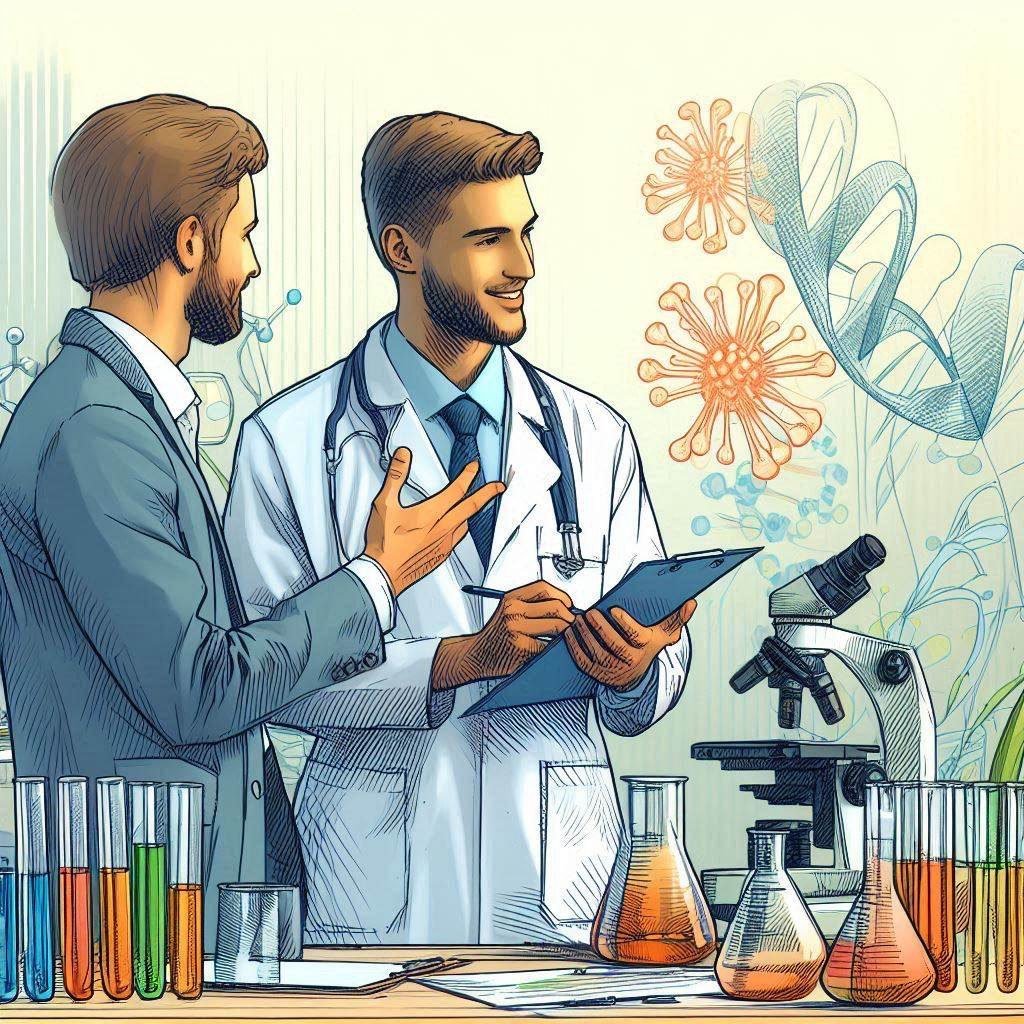
Think of us as the Gandalf of the scientific world, guiding users through the treacherous terrain of next-generation sequencing, automated imaging, or whatever the latest instrument may be.
“You shall not pass… without understanding how to operate this sequencer!”
Ok, but where do Field Application Specialists actually work in life science? Let’s look at the industries that are hiring them.
The FAS-cinating World of Biology: Where Can You Spread Your Wings?
Field Application Specialists can find their niche across a variety of biology-related industries, including:
- Biotechnology: Where we are the tech-savvy sidekick to scientists, showing them how to use cutting-edge equipment.
- Pharmaceuticals: Helping customers understand the technical aspects of pharmaceutical products and how to integrate them into their workflows.
- Clinical Diagnostics and Healthcare: Bridging the gap between complex diagnostic tools and healthcare professionals.
- Agricultural and Environmental Sciences: Demonstrating how high-tech applications can help feed the world and save endangered species.
In short, if there’s a scientific instrument that needs to be understood, optimized, and loved—there’s probably an FAS involved.
The FAS Work Setting: Have Lab Coat, Will Travel
Now, here’s where it gets interesting: Field Application Specialists aren’t tied to a single lab or office. Our “field” is—literally—the field. Most FASs are fully remote, working from home when not traveling to visit customers.

Picture this: On Monday, you’re in a cutting-edge lab in London, explaining the intricacies of a new instrument. By Friday, you’re troubleshooting via video call from your home office. And the week after? You might be on a plane to Stockholm, preparing for the next training session.
It’s a nomadic lifestyle. It’s dynamic, unpredictable, and definitely not for everyone. But if you thrive on variety, flexibility, and don’t mind living out of a suitcase, it’s downright exhilarating.
Ok but what exactly do Field Application Scientists do all day? Let’s jump in!
The FAS Responsibilities: The Many Hats of a Field Application Specialist
Alright, so you’re intrigued by the idea of being a scientific superhero who gets to travel. But what exactly will you be doing day-to-day? Let’s break it down:
- 🧪 Customer Training: Remember that time in the lab when you couldn’t figure out how to use that new fancy machine, and you wished someone would just appear and show you how? Well, that someone is you now!

As a Field Application Specialist, you’ll lead training sessions to help researchers and clinicians get comfortable and confident with complex technologies and products. You become their go-to person for mastering the tools that fuel their science.
- 🔍 Support & Scientific Consulting: We’re not just there to fix problems; we’re there to prevent them—like scientific ninjas swooping in before disaster strikes. We offer expert advice on experimental design, data analysis, and technical challenges. This part of the job allows us to flex our scientific muscles and really dive deep into the work our customers are doing.
- 🧠 Product Demonstrations: This is our time to shine. You’ll showcase cutting-edge technology and products to potential customers, highlighting how our tools can accelerate their research and work. It’s part product demo, part problem-solving session. The goal? To make clients see how our instrument fits perfectly into their scientific puzzle.
- 🤝 Sales Support: While you’re not typically directly involved in sales, your technical expertise will often be called upon to help close deals. Think of it as being the scientific wingman to the sales team (have you met Ted? …ehm I mean, Giuseppe?).
- 🧭 Bridging the Gap: Because you’re on the front lines, you see what customers love, hate, or wish existed. That makes you the perfect person to channel feedback to R&D, product managers, and tech support teams. In short: you’re the human interface between science users and the companies building the tools they rely on.

👉 P.S. Curious about the Product Manager path? That’s another fascinating industry role. Check out this post if you’re interested: Flourishing as a Science Product Manager: Your Ultimate Biologist’s Career Guide.
Besides these responsabilities, travelling is a big part of this role. Let’s discuss it in details!
The Travel Chronicles: Adventures of a Scientific Nomad
Business travel in life sciences is booming again post-COVID. As companies expand into new markets and realize some things still can’t be solved over Zoom, in-person visits are back on the agenda (hackernoon.com).
✈️ The Perks of Scientific Travel
In my humble opinion, FAS travel is a double-edged pipette. On one side, it’s amazing:
- You work on different projects, with different people, in different labs every week.
- You get paid to visit beautiful cities and countries.
- You can blend science with a bit of sightseeing.
I’ve swum in the Mediterranean while visiting a lab in Marseille, enjoyed a pint after training in Amsterdam, and even squeezed in a Vatican tour between customer meetings in Rome.
I mean—if you’re already there, why not enjoy it?

🌴 Bleisure, Anyone?
Another perk? Have you ever heard about “bleisure” travel? (yes, that’s a thing).
Over 60% of business travelers in the US extend their trips for a bit of personal time (stratosjets.com), and if your company’s cool with it, you can totally do the same as an FAS. I definitely take advantage of it whenever I can because, let’s be real, if you’re already in a new city, why not stick around and explore, right?
✋ The Less Glamorous Side of FAS Travel
But before you think it’s all sunshine and Aperol spritzes, let me be real for a second. Living out of a suitcase isn’t all that glamorous. There are days when airports start to feel like your second home, and don’t get me started on the endless packing, unpacking.
The biggest challenges are:

- Tiredness from travel: Being constantly on the move, sleeping in different hotels every week, and changing cities as often as Italy changes president, is exhausting. By the time Friday rolls around, I’m usually in desperate need of a weekend-long nap just to recover.
- Less time at home: My plants have developed trust issues, and I’m pretty sure my neighbor thinks I’m in witness protection. Maintaining relationships (both plant and human) requires extra effort when you’re always on the move. Plus, being away during the week makes it nearly impossible to cultivate hobbies. My guitar now gives me the silent treatment whenever I’m home.
- Limited freedom to plan weekday events: Goodbye, impromptu Tuesday night karaoke. Hello, frantically rescheduling dinner plans because a customer needs urgent support. My social calendar looks like a game of Tetris where the pieces never quite fit.
A Job Like No Other
Being a Field Application Specialist is a unique blend of science, travel, teaching, problem-solving, and adventure. It’s not for everyone—but if you thrive on variety, independence, and a fast-paced lifestyle, it can be incredibly fulfilling.
Just remember to water your plants before you leave.
And keep in mind, my experience—covering most of Europe—is on the more intense end of the spectrum. Some FAS roles cover just a single country or region (hello, work-life balance), while others span even larger territories (hello again, jet lag). Your experience will vary depending on the company and market.
The FAS Toolkit: Skills That Pay the Bills
So, you’re still here? Great! That means you haven’t been scared off by the idea of living out of a suitcase. Now let’s talk about what it actually takes to become a Field Application Specialist (FAS)—beyond a love for science and a decent carry-on.
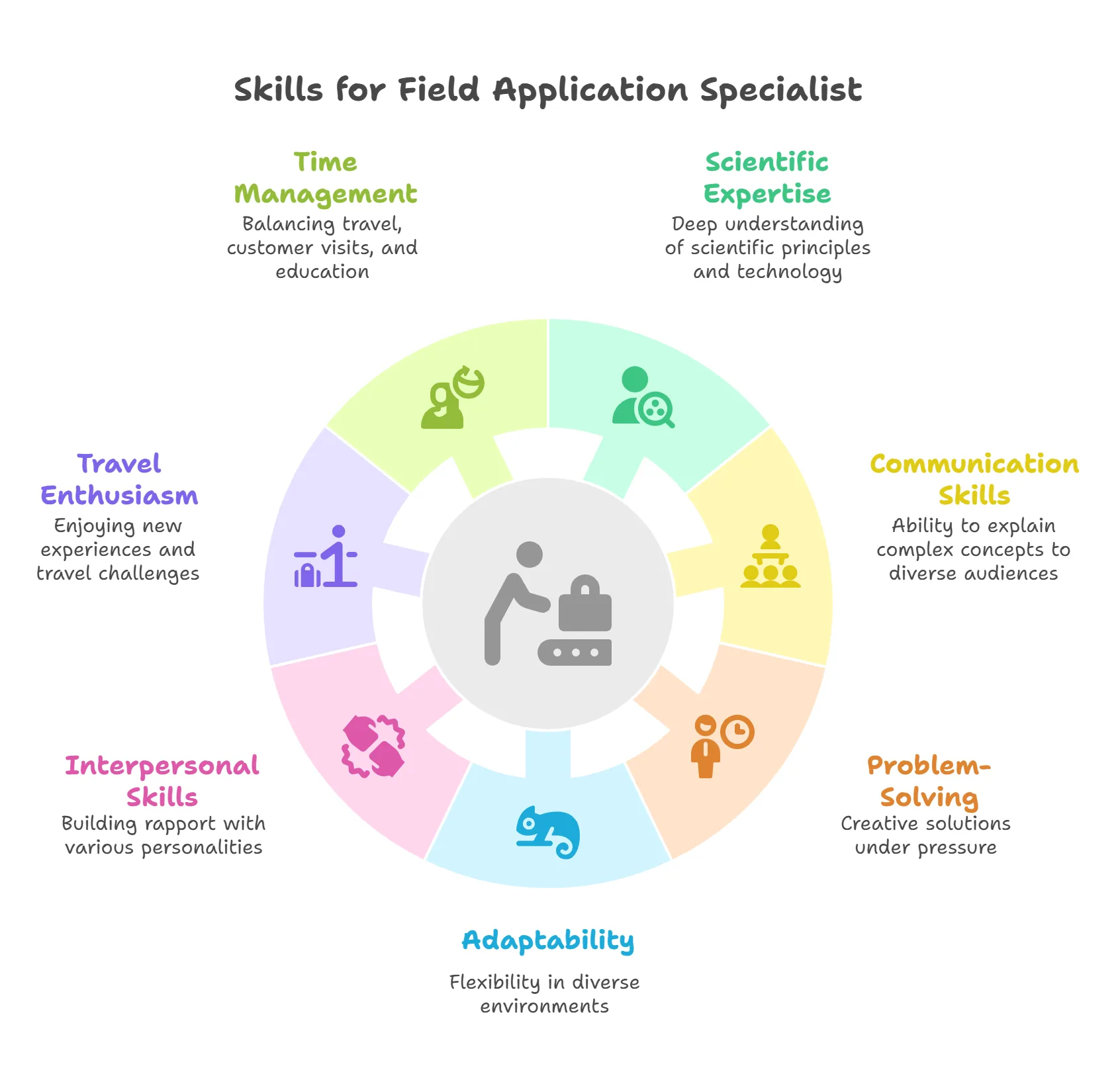
- 🧬 Scientific Expertise: You need to know your stuff inside out. This isn’t just about memorizing protocols—it’s about understanding the science behind the technology and being able to apply that knowledge across different contexts. You’ll often need to troubleshoot complex scenarios, adapt to diverse experimental setups, and answer questions on the fly. A solid foundation in biology, chemistry, or biomedical science is a must.

- 🎤 Communication & Presentation Skills: Can you explain single-cell sequencing to a PI and to a group of Master’s students without losing either audience? Perfect. As an FAS, you’ll constantly switch between scientific depth and accessibility. Clear communication is your superpower—especially when giving product demos, training sessions, or responding to customer questions.
- 🧠 Problem-Solving Skills: MacGyver has nothing on us. In this role, you’ll encounter problems you’ve never seen before, often with high stakes and time pressure. The ability to think on your feet and come up with creative solutions is invaluable.
- 🔄 Adaptability: Every lab is different, and international travel adds even more variety. One day you’re in a high-tech genomics center; the next, you’re helping a lab where the centrifuge is held together with duct tape and hope. Being flexible, culturally sensitive, and able to adapt to wildly different environments is a major asset.
- 🧑🤝🧑 Interpersonal Skills: As an FAS, you’ll meet everyone from shy PhD students to lab managers. Building a quick connection is part of the magic. It’s like finding common ground over a shared love of data, a stubborn instrument, or the best coffee near the lab. Empathy, patience, and knowing when to listen (instead of jumping in with the manual) will take you far. In the end, you’re not just solving technical puzzles—you’re building trust.
- ✈️ Travel Enthusiasm: If you don’t like living out of a suitcase, this might not be your cup of espresso. But if you thrive on new experiences and don’t mind the occasional flight delay or hotel mix-up, you’ll love this aspect of the job.
- ⏰ Time Management: With great flexibility comes great responsibility. You’ll often be managing your own schedule, balancing travel, customer visits, report writing, and ongoing education.
Do You Need a PhD to Be a Field Application Specialist?
Ah yes, the eternal question: To PhD or not to PhD? Here’s the lowdown:
- Bachelor’s degree: The minimum requirement—usually in biology, biotechnology, or a related field.
- Master’s degree: A definite plus. It shows you’ve gone deeper into research and technical understanding.
- PhD: Not always required, but definitely helpful—especially for roles involving advanced tech or academic customers.
According to Zippia, only about 9% of Field Application Specialists hold a PhD, while 52% have a bachelor’s degree and 14% have a master’s (zippia.com).

In my case, my PhD in molecular biology, was my golden ticket. It not only gave me deep scientific knowledge but also honed my research skills, problem-solving abilities, and perseverance (anyone who’s completed a PhD knows it’s as much a test of willpower as it is of intellect).
That being said, PhD is not always a strict requirement. Many companies value practical experience and strong technical skills just as much as (if not more than) advanced degrees.
👉 Wondering what to do with your PhD in biology? Check out this post: What Can You Do with a PhD in Biology? Discover Exciting Career Paths.
Ok, we discussed about skills and education requirments, what about previous experience?
Experience: Is Previous Lab Work Necessary?
Previous lab experience is like Parmigiano cheese in Italian cuisine—you can cook without it, but… why would you?. In my case, my PhD work was my main experience. But here’s what else helped:
- Teaching experience: Those hours spent explaining concepts to bachelor’s and master’s students? Pure gold. It taught me how to break down complex ideas and adapt my teaching style to different learners.
- International background: Being Italian but completing my PhD in Germany gave me a unique edge. It honed my adaptability, language skills, and cultural sensitivity.
- Working in an international lab: Hello, multicultural competence! My lab was like a mini-UN, with researchers from all over the world. This experience was invaluable in preparing me to work with diverse customers.
- My secret weapon: Previous experience as a waiter. Surprised? Don’t be. Those customer service skills – dealing with complaints, managing expectations, staying calm under pressure – are surprisingly transferable to the world of scientific support.

Remember, companies are often looking for a mix of scientific knowledge and soft skills. So don’t discount any of your experiences, even if they seem unrelated at first glance.
Interesting, right? But you know what’s even more interesting? Salaries!
FAS Salaries Around the World: What Can You Expect?
Alright, let’s talk numbers—because passion is great, but rent still needs to be paid.
Field Application Specialist salaries vary based on location, experience, company size, and sometimes even how many languages you can say “micropipette” in. Here’s a general salary range by country to give you an idea:
- North America: $70,000 – $120,000
- United Kingdom: £40,000 – £70,000
- Germany: €50,000 – €80,000
- Italy: €35,000 – €60,000
- France: €40,000 – €70,000

Keep in mind, these are averages. Factors like niche expertise, negotiation skills, and company perks can shift your compensation package significantly. Your mileage (and frequent flyer status) may vary!
But salary is just one part of the equation. A bigger question is: Where a Field Application Specialist career can bring you to?
The FAS Career Path: Where Can It Take You?
The beauty of the Field Application Specialist role is that it can be a springboard to various career paths. It’s like standing at a scientific crossroads—you’ve built a versatile skill set, and now you can choose which direction to go.
Here are some common next steps FASs take:
- Product Management: Want to shape the future of scientific instruments? Your firsthand knowledge of customer needs is invaluable in this role.
- Applications Development: Use your knowledge to help develop new applications for existing technologies.
- Technical Support Management: Lead a team of specialists, using your field experience to guide and mentor others.
👉 PS: I wrote a whole article about Tech Support Scientist role: Technical Support Scientist: Your Gateway to a Thriving Career in Life Science.

- Sales and Marketing: Many FASs transition into sales roles. Your deep product knowledge and customer relationships make you a natural fit.
- Consulting: Your broad experience across different labs and technologies can position you well for consulting roles.
- Training and Education: Some FASs move into full-time training roles, developing curricula and leading workshops.
The truth is, this job gives you a panoramic view of the industry, which makes it easier to pivot when the time is right.
And while that sounds exciting, let’s be honest—every shiny coin has two sides. The FAS lifestyle can be thrilling one moment and completely draining the next.
Pros and Cons of Being a Field Application Specialist
Let’s keep it real: the FAS lifestyle isn’t for everyone. It can be exhilarating and exhausting, often in the same week. Here’s what you should know.
✅ Pros:
- The Reward of Helping Others: There’s an incredible sense of satisfaction when you help researchers overcome challenges or master new techniques. The gratitude you receive after successfully troubleshooting an issue or delivering an enlightening training session is genuinely heartwarming. It’s like being a scientific Yoda, minus the pointy ears and backwards syntax (maybe after long journey).
- Networking with Scientists Worldwide: You’ll build a global network of contacts in your field. It’s like LinkedIn, but face-to-face. You’re always meeting new people, from fresh-faced PhD students to seasoned principal investigators, each with their unique perspectives and experiences.
- Travel Opportunities: See the world on the company’s dime. I’ve seen more of Europe in the past few years than I did in my entire life before becoming an FAS.
- Bridging Academia and Industry: If your customers include universities or research institutions, you’ll get to stay close to academic science while enjoying the perks of industry.
❌ Cons:
- Time Away from Home: This can be tough on personal relationships and make it challenging to maintain a consistent routine and a proper work-life balance.
- Unpredictable Schedule: Plans can change at a moment’s notice when a customer has an urgent need. Flexibility is key, but it can be stressful.
- High-Stress Situations: Ever dealt with a broken million-dollar machine while the customer breathes down your neck? It’s not for the faint of heart.
- Physical Demands: Frequent travel and long days on your feet can be tiring. It’s not all glamorous jet-setting!

According to Zippia, FASs report relatively high job stress (6.7/10) and frequent challenges (6.5/10). That said, they also rate work-life balance at 7.4/10 (zippia.com)—though I personally find that number… optimistic, especially if you’re flying every other week.

Is It Worth It?
Despite the jet lag, scheduling chaos, and the occasional airport sandwich dinner, I can confidently say: yes, it’s worth it. This role helped me unlock skills I never thought I had, discover new corners of the world, and even reinvent myself professionally.
But let’s be clear—being a Field Application Specialist isn’t just a job, it’s a lifestyle. You have to enjoy variety, thrive in uncertainty, and be willing to spend more time on trains and planes than your living room couch. It’s not for everyone, and that’s okay.
Still, just when you think you’ve figured it all out, a new player enters the scene…
How AI Is Changing the Game for FAS Professionals
As we look to the future, the role of Field Application Specialist is evolving and, of course, Artificial Intelligence is a main player in it shaking things up, and not just by trying to steal our jobs (don’t worry, it can’t travel as fabulously as we do).
Here’s how AI will be impacting our field:
- Customer Service Enhancement: AI is helping automate routine inquiries, leaving us more time for complex problem-solving. Chatbots can handle basic troubleshooting, freeing us up for more challenging issues.
- Data-Driven Personalization: AI tools can analyze customer behavior and usage data, helping us tailor training, troubleshooting, and even upselling strategies to each lab’s unique needs.
- Predictive Maintenance: By tracking how instruments are used and how they perform, AI can spot warning signs before real trouble hits—turning us into the closest thing science has to crystal-ball readers.
- Smarter Knowledge Access: AI-powered search tools can instantly surface technical documents, FAQs, or case studies we need—cutting down on the hours spent digging through folders.
👉 If you are curious how I am using basic free AI tools for my daily tasks as an FAS, check out this post: 10 Essential Free AI Tools for Scientists I Can’t Work Without.
But fear not, fellow humans! Field Application Specialist is a role where face-to-face interaction and human relationship builing is essential. The need for that personal touch, the ability to read a room (or a lab), and the skill to explain face to face, complex concepts in simple terms – that’s all still on us.
So, AI is a tool that’s making us more efficient, not a replacement for the human expertise and intuition that’s at the heart of what we do.
Wrapping It Up: Is Field Application Specialist the Right Fit for You?
So, there you have it – the inside scoop on life as a Field Application Specialist. It’s a role that combines scientific expertise with people skills, problem-solving with frequent flyer miles.
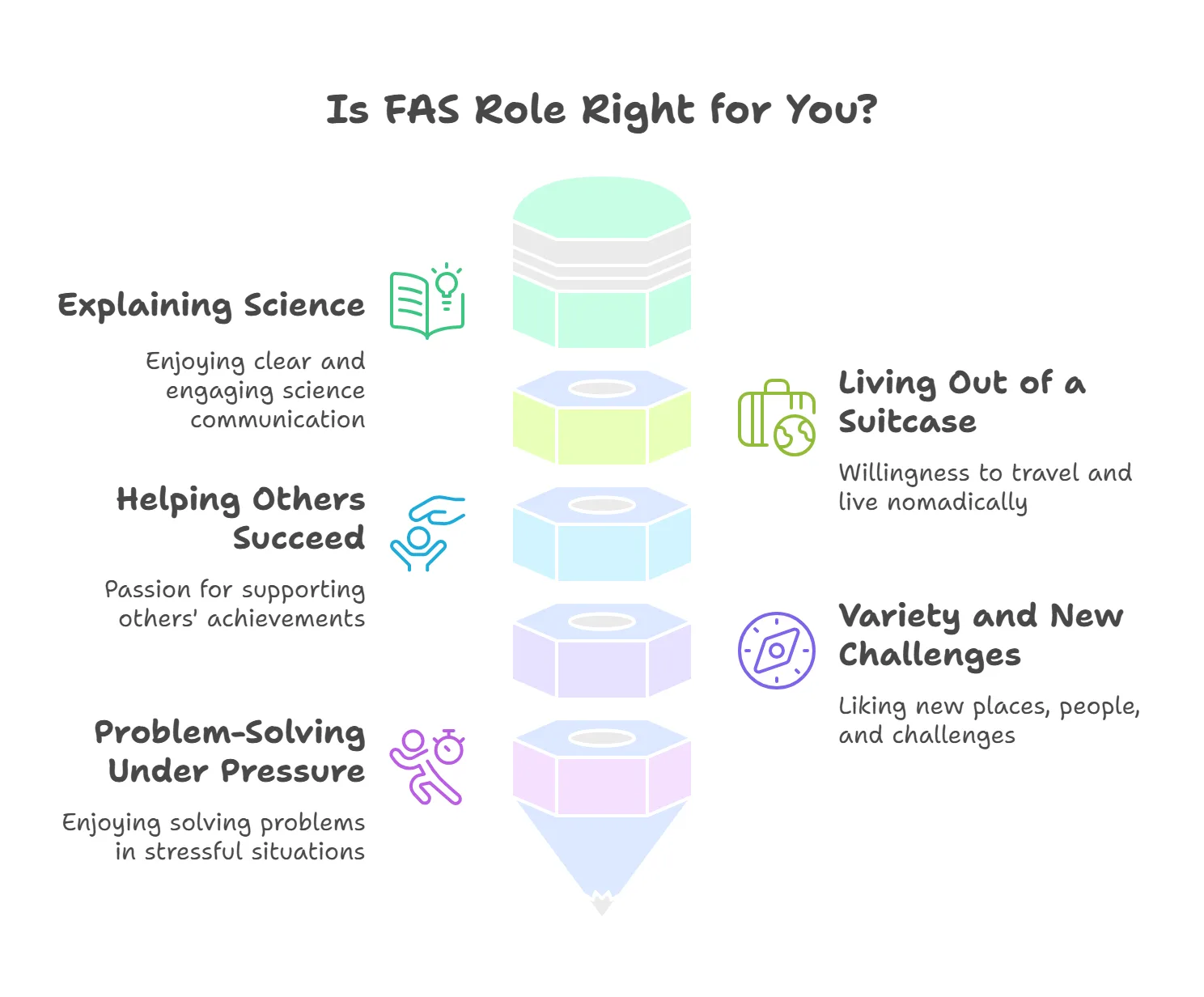
Here’s a quick checklist. If most of these sound like you, then you’re onto something:
✅ You enjoy explaining science in a clear, engaging way
✅ You don’t mind living out of a suitcase
✅ You’re energized by helping others succeed
✅ You like variety—new places, new people, new challenges
✅ You secretly enjoy problem-solving under pressure
If that got your curiosity tingling—great. Because this job might just give you the scientific adventure you didn’t know you were looking for.
My Final Take: A Role That Transformed My Career
I didn’t plan on becoming a Field Application Specialist. I stumbled into it. But it ended up being the most rewarding detour of my career. Sometimes the best career moves are the ones you didn’t even know existed.
Being an FAS has allowed me to stay connected to cutting-edge science while satisfying my wanderlust. It’s challenged me to grow not just as a scientist, but as a communicator, a problem-solver, and a global citizen.
Sometimes I feel drained from long flights, but then I remember: I get to travel to amazing cities across Europe, meet fascinating people, and help passionate scientists—all while being paid for it. That’s why I love this job.
So, if you’re standing at a career crossroads, wondering where your science degree could take you beyond the traditional research path, consider the world of Field Application Specialist. It’s a road less traveled, but for the right person, it can lead to an incredibly rewarding journey.

Join the CuriosityBloom Community!
So—what’s your take?
Does the Field Application Specialist lifestyle sound like your kind of adventure, or do the frequent flyer miles and tight schedules give you pause?
Are you already in the field, just breaking in, or weighing a career pivot from academia or the lab bench?
Let’s talk! I’d love to hear your thoughts:
- 💬 Drop a comment below – What excites you most about the FAS role? What concerns you? Is it the science, the travel, the customer connection… or the airport food?
- 🔄 Share this post—(Buttons below 👇) Know a scientist curious about non-traditional career paths? Forward this to them and help spread the word about a role that blends science, travel, and real-world impact.
- 📩 Subscribe to the Curiosity Bloom newsletter – Get fresh posts on careers in science, industry insights, mental health, and how AI is reshaping our world—always with a pinch of humor—right in your inbox.
- 🚀 Curious for more? – Explore other articles on life science careers, AI tools for scientists, and the wild ride of working outside the lab. There’s plenty more to discover!
Grazie for reading! 🌟
FAQ: Everything You Wanted to Know About Being an FAS But Were Afraid to Ask
Do I need to be an extrovert to be a successful FAS?
Not necessarily! While good communication skills are crucial, many introverts excel in this role (me included). It’s more about being able to connect with people and explain concepts clearly than being the life of the party. In fact, the ability to listen carefully and think deeply about problems – traits often associated with introverts – can be huge assets in this job.
How much time do FASs typically spend traveling?
It varies, but many FASs spend about 50-80% of their time on the road. In my case, it’s closer to 70%, but it can fluctuate depending on customer needs and project timelines. Some weeks I might be home every night, while others I might be bouncing between different countries.
How has the pandemic affected the FAS role?
While there was a dip in travel during the height of the pandemic, we’ve seen a resurgence in face-to-face meetings. Many aspects of the job adapted to remote formats, but the demand for in-person support is bouncing back strong. That said, the pandemic has accelerated the development of remote support tools, giving us more flexibility in how we assist customers.
Do I need to be fluent in multiple languages to be an FAS?
While it’s not always a requirement, being multilingual can definitely be an advantage, especially if you’re covering an international territory. In my case, speaking Italian, English, and some German has been incredibly helpful. But don’t worry if you’re not a polyglot – many companies provide language training for FASs.





Hi! I’m from the UK and have recently graduated with an Integrated Masters in Human Biology. I’m currently working as a Research Technician in a university lab, and I was wondering If anyone would be able to advise me on what sort of work experiences Life science manufacturers look at for prospective FAS to have, or not have if that’s relevant. I’m particularly interested in the more smaller territory roles long term if that helps also😊.