Skip to content
Introduction | Prompt Engineering in Life Science: A Practical Framework
Ciao a tutti, Giuseppe here!
Every day, thousands of biologists are asking AI the wrong questions, using the wrong prompts for biology, and getting generic answers that waste their time.
You know the feeling: you paste in a methods section hoping for clarity, and ChatGPT spits out something so vague it could describe any experiment from the last decade. You ask for help designing primers, and get a textbook definition instead of actionable sequences. The promise of AI feels far from the reality.
But here’s what most people don’t realize: the problem isn’t the AI. It’s how we’re talking to it.
The gap between “AI gave me nothing useful” and “AI just saved me 10 hours this week” comes down to one skill: prompt engineering for biology. And unlike learning qPCR optimization or mastering flow cytometry, this skill takes hours to learn.
I’m a molecular biologist turned field application scientist who became obsessed with making AI actually work for the messy, specific, real-world problems we face in life sciences.
Since implementing the framework I’m about to share with you, my productivity basically doubled. Literature summaries that used to take 3 hours now take 45 minutes. Customer emails? Down from 30 minutes to 10. Protocol drafts? 2 hours to 30 minutes. That’s over 10 hours saved per week, and I’m still discovering new ways to improve.
The difference between struggling with AI and wielding it like a power tool isn’t mysterious. It’s a framework.
And that’s exactly what I want to share with you today, not as an AI guru, but as a fellow biologist who’s learned through trial and error what actually works in the real, messy world of life sciences. Let’s dive in.

Why Prompt Engineering Matters for Every Biology Professional
AI doesn’t read minds, it follows instructions. Vague prompts give vague results. In biology, where precision determines whether your experiment works or your grant gets funded, vague isn’t an option.
This is exactly why prompt engineering for biology is becoming a core skill for modern life scientists.
Prompt engineering is calibration for AI. You wouldn’t run a Western blot without optimizing antibody concentrations or skip calibrating your flow cytometer before an important experiment. The same logic applies here: give AI the right structure, context and direction = get usable outputs.
And this matters across all life science roles. Whether you’re summarizing literature for a grant, preparing a customer demo as a field application specialist, writing an SOP draft for regulatory submission, troubleshooting a failed experiment, or crafting a product comparison for a sales pitch, clarity and accuracy aren’t optional.
AI tools are already embedded across life sciences, revolutionizing everything from drug discovery to clinical trials (AI revolutionizing life sciences). But most organizations struggle to translate adoption into productivity (usdm.com). The difference? Their people know how to craft effective AI prompts for biology.
👉(If you want to go deeper into why AI won’t replace biologists, but will fundamentally change how we work, check out Why AI Won’t Replace Biologists (But Will Transform How We Work)).
👉(And if you’re curious about how this shift is already reshaping careers across academia, biotech, and industry, AI Impact on Biology Jobs: Thriving in a Changing Landscape breaks it down in detail).
The competitive advantage isn’t access to AI anymore. Everyone has that. It’s knowing how to use it properly.
What Is Prompt Engineering? (No Jargon, Promise)
Ok, we just saw why prompt engineering is becoming a critical skill for biology professionals. Now let’s get clear on what it actually is,without hype and buzzwords.
Prompt engineering is the structured way of giving instructions to AI so it returns information aligned with your goal.
That’s it. Not coding. Not math. Not magic. Just being clear, specific, and intentional.
It’s like the difference between asking a colleague:
“Could you look into this?”
versus:
“Could you summarize the key findings from these three papers, focusing on limitations and experimental design?”
One leaves them guessing. The other gets you exactly what you need (assuming your colleague is kind enough to help you 😉).
Prompt engineering works the same way. The better you define context, expectations, and constraints, the better the AI performs.
The good news? You don’t have to invent this from scratch. Major AI developers have already published clear, practical guidance on how to prompt effectively:
| Company (AI Model) | Best For | Link |
| OpenAI (ChatGPT) | General-purpose prompting, creative tasks | best practices for prompt engineering |
| Google (Gemini) | Research integration, citations | what is prompt engineering |
| Microsoft (Copilot) | Integration with Office tools | learn about copilot prompts |
| Meta (Lama) | Open-source, on-device processing | how to guides – prompting |
| Mistal AI (Mistral) | European alternative, multilingual | prompting_capabilities |
| Anthropic (Claude) | Long documents, technical analysis | prompt engineering overview – prompt engineering best practices |
| Perplexity AI (Perplexity) | Research integration, citations | prompt guide |
You don’t need a computer science degree, you just need to understand what information AI needs from you.
👉(Prompt engineering in biology and life sciences is essential, but it’s not the only skill that matters. If you’re curious about the other non-coding AI skills that are becoming critical for biologists, take a look at: 5 ‘Non-Coding’ AI Skills That Boost Your Biology Career).
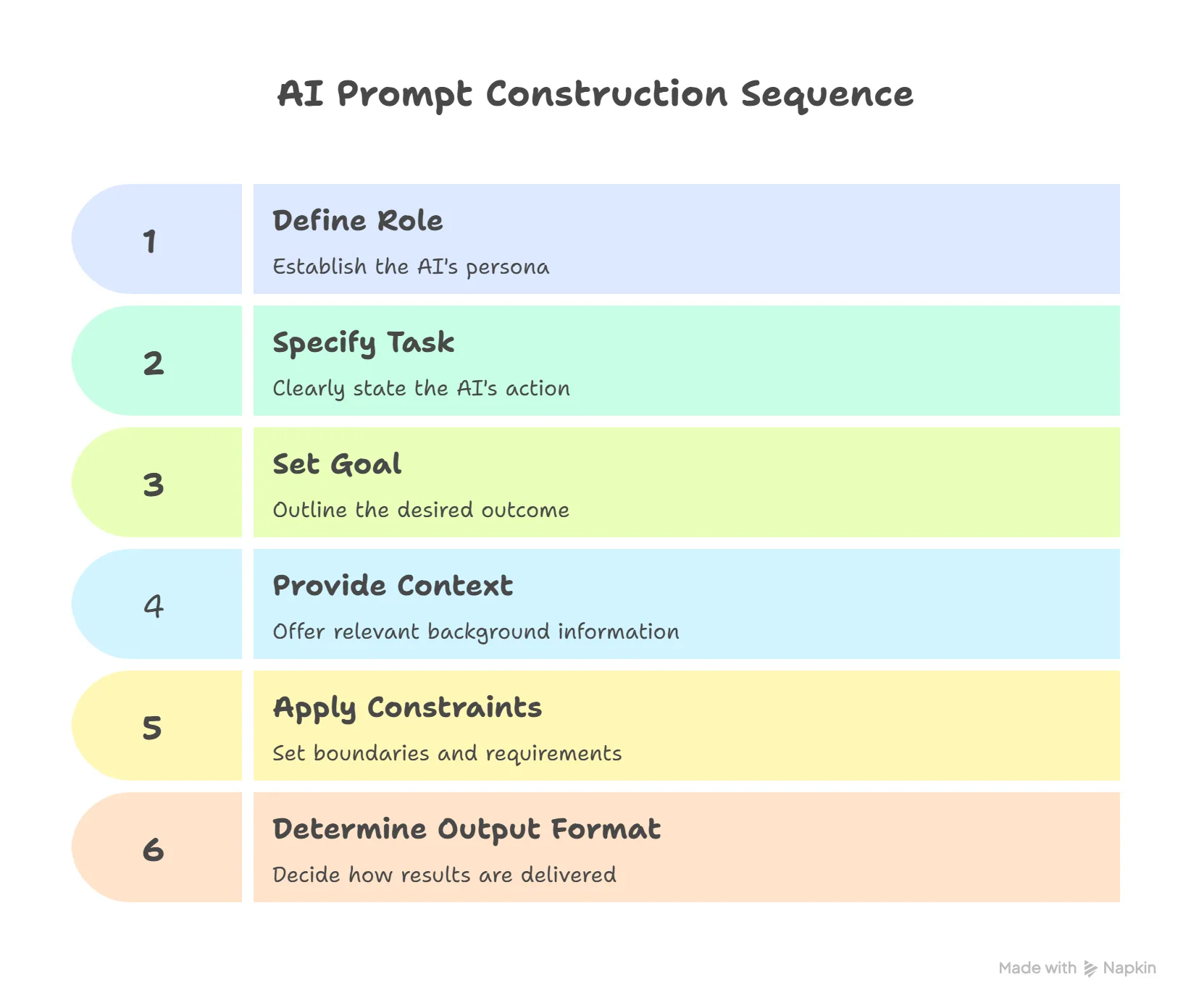
The 6-Element Framework for Powerful AI Prompts in Biology
If you don’t want to spend hours digging through prompt engineering guides, and want something you can apply today to craft useful AI prompts for biology, this is the framework I use myself.
I’ve tested and refined it across real biology workflows: drafting technical documentation, preparing customer meetings, analyzing literature, and troubleshooting experiments. You don’t always need all six elements, but the more you include, the better and more reliable your results.
Think of this as a practical formula for writing AI prompts for biology that actually work.
Element 1: ROLE—Who the AI Is “Pretending” to Be
What it is: Tell the AI what expert perspective to adopt.
Why it matters: A PhD researcher needs different depth than a purchasing manager evaluating your product. Different roles trigger different vocabularies, assumptions, and levels of technical detail. The AI adjusts its entire approach based on who it thinks it’s speaking as.
Examples:
- “Act as a regulatory affairs specialist reviewing IND submissions…”
- “You are a molecular biologist with 10 years of qPCR experience…”
- “Respond as a field application specialist speaking to cancer researchers…”
Quick demonstration:
❌ Without role: “Explain CRISPR”
✅ With role: “Act as a molecular biologist. Explain CRISPR to cell biologists who are considering using it for the first time.”
Result: More targeted depth, appropriate language level.
Element 2: TASK—Tell the AI What to Do
What it is: The action you want the AI to perform.
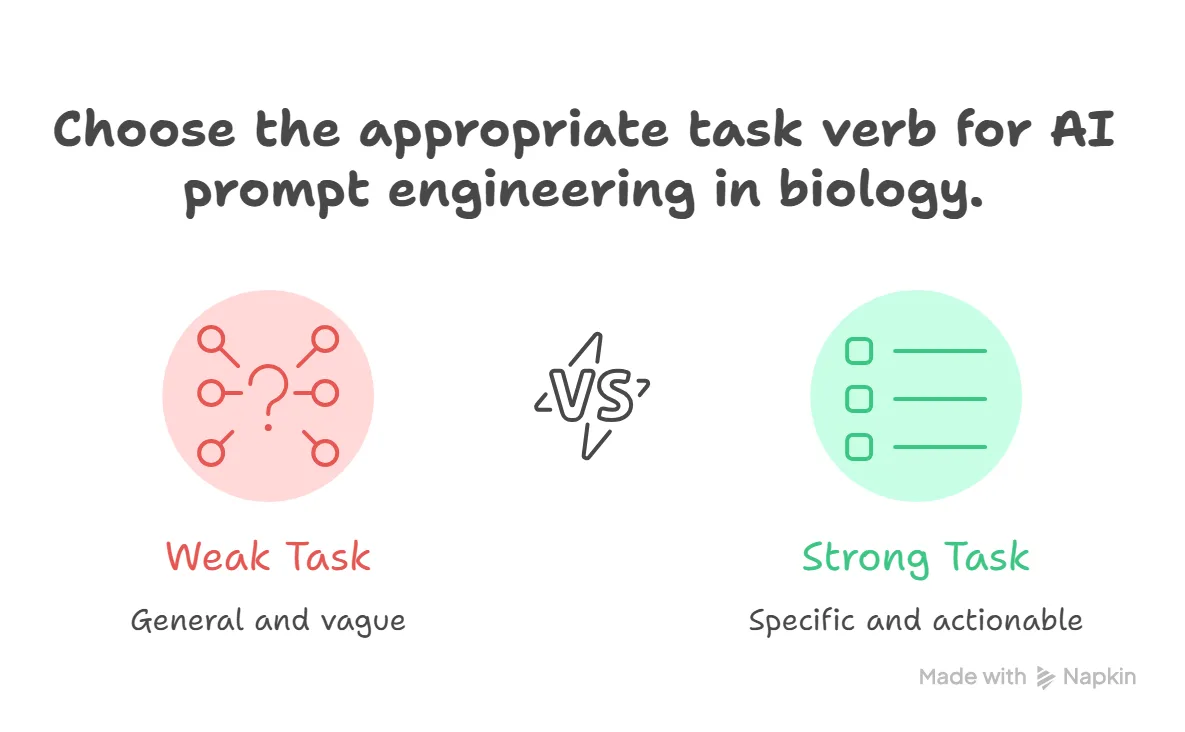
Why it matters: Clear action → clear output. Specificity in your task verb directly determines output quality. “Tell me about” gets you a Wikipedia entry. “Generate a troubleshooting checklist” gets you something you can actually use Monday morning.
Common task verbs for life scientists: Summarize, compare, explain, analyze, list, rewrite, troubleshoot, generate, translate, evaluate, draft, review, critique, optimize, design, validate
Quick demonstration:
❌ Weak task: “Tell me about Western blot problems”
✅ Strong task: “Generate a step-by-step troubleshooting checklist for high background signal in Western blots, organized by most common causes”
Result: Actionable output instead of a textbook explanation.
Element 3: GOAL—Purpose Shapes Output
What it is: The end purpose. What you’ll actually do with this output once AI generates it.
Why it matters: The same scientific information serves different purposes depending on your goal. A protocol summary for a grant needs to emphasize novelty and rigor. The same protocol for training undergrads needs to emphasize clarity and safety. Goal shapes everything: tone, detail level, what gets emphasized, what gets left out.
Examples:
- “…for the methods section of a grant proposal”
- “…to prepare talking points for a customer demo next week”
- “…for training undergraduate researchers who will run this independently”
- “…to include in a regulatory submission document”
Quick demonstration:
❌ No goal: “Summarize this protocol”
✅ With goal: “Summarize this protocol for training undergraduate researchers who will run it independently”
Result: Appropriate detail level and instructional tone, and focus on practical execution rather than theory.
Element 4: CONTEXT—Give the Background That Matters
What it is: Background information that helps AI understand your specific situation and constraints.
Why it matters: Context is the difference between a textbook answer and one that actually fits your reality. It shapes tone, technical depth, what assumptions AI makes, and what solutions it suggests. Without context, you get generic. With context, you get relevant.
Types of context to include:
- Audience expertise: “Speaking to cancer researchers with limited flow cytometry experience”
- Current situation: “We’re troubleshooting a failed experiment that worked last month”
- Field-specific details: “This is for a GMP-regulated manufacturing facility”
- Previous attempts: “We’ve already tried increasing blocking time and switching buffers”
- Equipment constraints: “Using a BD FACSCelesta with 5 lasers”
Quick demonstration:
❌ No context: “Explain flow cytometry compensation”
✅ With context: “Explain flow cytometry compensation to a postdoc who understands cell biology but has never used a flow cytometer. Focus on practical steps, not theory.”
Result: Right depth, right approach.
Element 5: CONSTRAINTS—Set Boundaries and Requirements
What it is: Requirements, limits, boundaries, and exclusions for the output.
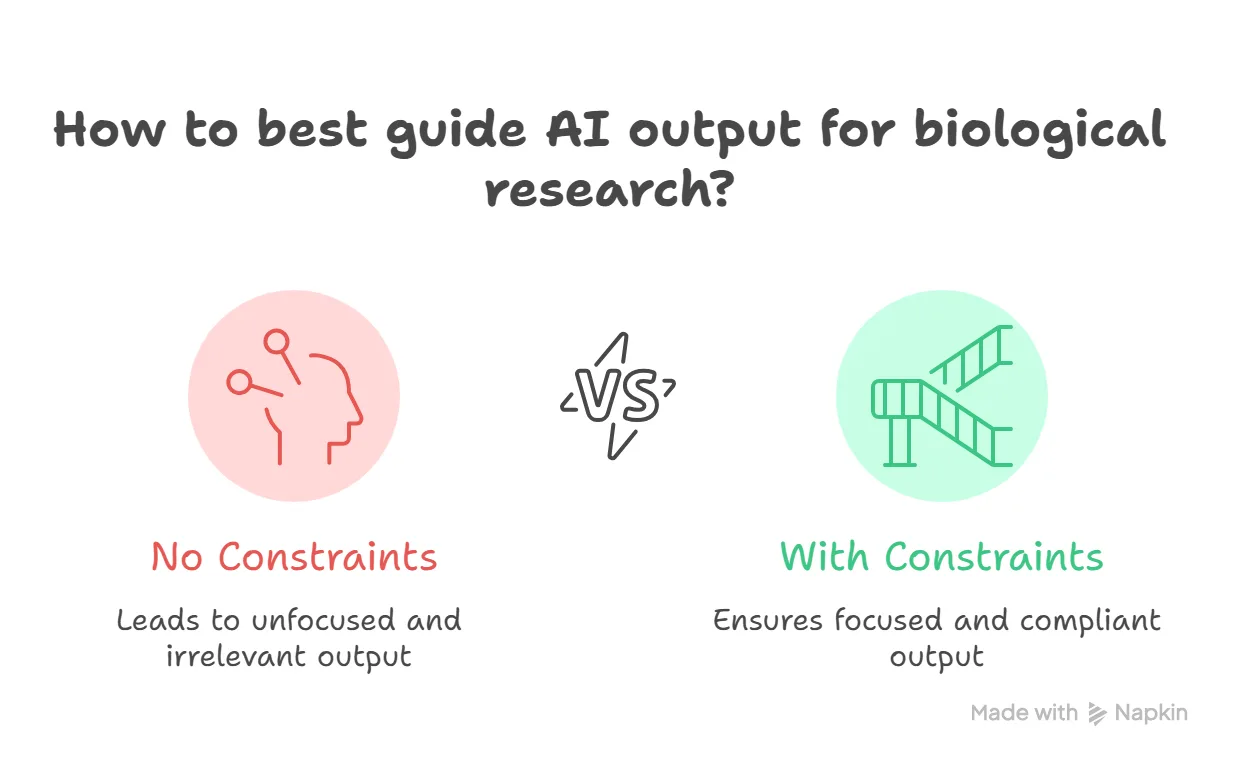
Why it matters: Constraints prevent AI from going off on tangents or including information that’s irrelevant to your actual needs. They keep outputs focused, compliant, and immediately usable. Think of constraints as guard rails that keep AI on your specific track.
Types of constraints:
- Length limits: “Keep under 500 words” or “Maximum 3 bullet points per section”
- Standard compliance: “Follow ISO 13485 terminology” or “Use ICH guidelines”
- Exclusions: “Avoid technical jargon” or “Don’t include pricing information”
- Inclusions: “Include only peer-reviewed sources from 2020-2024”
- Requirements: “Must include sample sizes, statistical methods, and control groups”
- Tone restrictions: “Professional but not overly formal”
Quick demonstration:
❌ No constraints: “Review this antibody data”
✅ With constraints: “Review this antibody validation data. Include only: target specificity, recommended dilution range, and validated applications. Keep to 3 bullets maximum. Exclude pricing and vendor details.”
Result: Focused, scannable output with exactly what you need and nothing you don’t.
Element 6: OUTPUT FORMAT— Decide How Results Are Delivered
What it is: How you want the information structured and presented.
Why it matters: The right format makes outputs immediately usable with zero reformatting. This is where you save the most time, going from “now I need to reorganize this” to “copy, paste, done.” Format also affects how easy information is to scan, share, and act on.
Common formats for life scientists:
- Comparison table with specific columns
- Numbered protocol checklist
- Bullet points (specify quantity and structure)
- Step-by-step experimental workflow
- Decision tree or troubleshooting flowchart
- Single dense paragraph for methods sections
- Summary with separate “Key Findings” and “Limitations” sections
Quick demonstration:
❌ No format: “Compare these three antibodies for Western blotting”
✅ With format: “Compare these three antibodies in a table with columns: Antibody Name | Clone | Host Species | Validated Applications | Working Dilution | Approximate Cost. Add a final row recommending the best option for detecting low-abundance proteins.”
Result: Copy-paste ready, easy to share or include in a presentation.
Putting It All Together: The Complete Formula for Prompt Engineering in Life Science
The formula: [ROLE] + [TASK] + [GOAL] + [CONTEXT] + [CONSTRAINTS] + [OUTPUT]
Remember: You don’t always need all six elements. But each one you add makes your output more targeted, more usable, and more aligned with what you actually need.
Start with this minimum: Role + Task + Output Format. Then add the others as your prompts get more complex or when you’re not getting the results you want.
BioPrompt Studio: A Hands-On Prompt Training Tool for Biologists
To help you master this framework, I developped BioPrompt Studio, an interactive tool to improve your prompt engineering skills specifically designed for biology and life science.
You can experiment with these six elements and see in real-time how each one changes AI outputs. You’ll be able to generate exaples for each of these elements, compare results side-by-side, improve your own prompts, and build your prompt engineering intuition through practice.
Want free access when it launches? Sign up for my newsletter and you’ll be the first to know.
Real Before/After AI Prompt Examples Across Biology Careers
Theory is fine, but let’s see this framework in action. Each example shows the same request, first without the framework, then with it, so you can see the difference these six elements actually make in generating much better AI prompts for biology.
Example 1: Literature Summary (AI prompts for Research & Academia)
BEFORE (Weak Prompt):
“Summarize recent papers about cellular senescence.”
AFTER (Strong Prompt):
[ROLE] Act as a molecular biologist preparing a grant proposal.
[TASK] Summarize 5 peer-reviewed papers
[GOAL] for use in a grant introduction’s background section
[CONTEXT] focusing specifically on cellular senescence in human fibroblasts and its role in aging
[CONSTRAINTS]
- Include only papers from 2022-2026
- For each paper include: one-sentence key finding, primary experimental assay used, sample size (n=?), and two major limitations
- Prioritize papers with in vivo validation
[OUTPUT] Format as a table with columns: Citation | Key Finding | Primary Assay | Sample Size | Limitations
THE RESULT:
Before: A meandering paragraph mixing cell types, species, and timelines. You’d spend 20 minutes reformatting and fact-checking just to make it usable. Essentially a Wikipedia-style summary that doesn’t help you write.
Check the answer with the weak prompt: Before – Weak Prompt
After: A clean, scannable table with findings, methods, statistical power, and limitations clearly separated. You can copy it directly into your grant and start drafting specific aims immediately. This is a much better way to generate ai prompts for research.
Check the answer with the strong prompt: After – Strong Prompt
Why it works: Role ensures appropriate academic tone and depth. Context narrows the scope to exactly your research area. Constraints enforce scientific rigor. Output format eliminates all reformatting work.
Example 2: Customer Communication (AI prompts for Field Application Specialist / Sales)
BEFORE (Weak Prompt):
“Explain the advantages of our single-cell RNA sequencing platform.”
AFTER (Strong Prompt):
[ROLE] Act as a field application specialist with expertise in genomics, speaking to an immunology research group.
[TASK] Create talking points explaining the advantages of our single-cell RNA sequencing platform
[GOAL] for the opening 3 minutes of a technical presentation to a lab considering switching from bulk RNA-seq
[CONTEXT]
- Customer currently uses bulk RNA-seq for immune cell profiling
- Main pain point: can’t resolve heterogeneity within T cell populations, getting averaged signals
- Research focus: identifying rare regulatory T cell subsets in tumor microenvironment
- Team concern: worried about cost per sample and bioinformatics complexity
- Technical level: strong molecular biology background, limited single-cell experience
[CONSTRAINTS]
- Address their heterogeneity pain point immediately, don’t lead with general platform capabilities
- Avoid overwhelming them with throughput numbers or channel specifications
- Focus on: resolution of rare populations, biological insights they’re currently missing, workflow similarity to what they know
- Include one concrete example: discovering a rare Treg subset that’s masked in bulk data
[OUTPUT] Format as 4 talking points, each 2-3 sentences, that bridge from their current bulk RNA-seq experience to single-cell advantages
THE RESULT:
Before: Generic feature list about “thousands of cells per run” and “comprehensive transcriptome profiling” that could be copied from your marketing brochure. Nothing connects to why this lab should care or what problems they’re actually trying to solve.
After: Focused narrative that opens with their exact frustration, explains what they’re missing, and bridges from their familiar bulk workflow to single-cell resolution.
Why it works: Context captures both their scientific goal and their concerns, letting you address what matters. Constraints keep you focused on their transition from bulk to single-cell rather than drowning them in specifications. Output format creates a logical narrative bridge from their current reality to what’s possible.

Example 3: SOP Drafting (AI prompts for Regulatory / Quality Assurance)
BEFORE (Weak Prompt):
“Describe how to store this reagent.”
AFTER (Strong Prompt):
[ROLE] Act as a quality assurance specialist preparing documentation for a GMP-regulated biologics manufacturing facility.
[TASK] Write a complete storage and handling section
[GOAL] for inclusion in a master SOP that will undergo regulatory review for ISO 13485 compliance
[CONTEXT]
- Reagent: temperature-sensitive fluorophore-conjugated antibody used in final product release testing
- Required storage: –20°C ± 5°C
- Validated stability data available for 12 months under proper storage
- Facility experiences occasional freezer temperature excursions during maintenance
- This section must align with existing SOP templates in the quality management system
[CONSTRAINTS]
- Use ISO 13485-compliant terminology and structure
- Include: storage temperature and acceptable deviation limits, transportation requirements from receiving to storage, stability/expiration information, deviation documentation requirements
- Keep to maximum 250 words
- Use shall/must language per regulatory standards
[OUTPUT] Format as a numbered SOP subsection (section 4.2) with clear, actionable procedures
THE RESULT:
Before: “Store at –20°C.” That’s it. An auditor would flag this immediately as insufficient for GMP operations. There’s no guidance on acceptable deviations, no stability information, no documentation requirements.
After: A complete, audit-ready SOP section with temperature ranges, deviation limits, cold-chain handling, stability dating, and proper regulatory language. Minimal editing required before submission.
Why it works: Role enforces regulatory rigor. Context supplies technical detail. Constraints ensure compliance. Output format matches SOP expectations exactly.
Advanced Techniques (Once You Master the Basics)
Once you’re comfortable with the 6-element framework, you’ll notice something important: good AI prompts for biology don’t just produce better answers, they let you guide how the AI thinks and responds.
These advanced techniques build on the same foundation. They’re not replacements for the framework, but extensions of it. You won’t need them for every task, but when biology gets messy, complex data, ambiguous results, high stakes, they can dramatically improve reliability and control.
Technique 1: Few-Shot Prompting (Using Examples)
What it is: You show the AI the pattern you want by providing a few examples.
When to use it: When formatting, tone, or structure really matters, and is hard to describe precisely in words. This is especially useful for figure captions, methods sections, reports, and regulatory-style writing.
Example:
Write figure captions following these examples:

Example 1: "Figure 1. Western blot analysis of protein X expression in HeLa cells treated with compound Y (10 μM, 24h). β-actin serves as loading control. Representative of n=3 independent experiments."

Example 2: "Figure 2. Flow cytometry analysis showing percentage of CD4+ T cells in treated vs. control groups (n=5 per group). Data shown as mean ± SEM."

Now write a caption for: [describe your experiment]
Why it works: Instead of guessing your expectations, the AI mirrors the structure, tone, and level of detail you’ve already approved.
Technique 2: Chain-of-Thought Prompting
What it is: You ask the AI to reason step by step rather than jumping straight to an answer.
When to use it: For complex problems, troubleshooting experiments, analyzing unexpected results, or designing studies.
Example:
“Walk through your reasoning step-by-step:
- First, identify the most likely causes of high Western blot background
- Then, rank them by probability based on the protocol I provided
- Finally, suggest troubleshooting steps in priority order”
Why it works: This slows the model down and forces structured thinking, much closer to how scientists reason through problems.

Technique 3: Iterative Refinement
What it is: You treat AI output as a draft, then feed it back into the next prompt to progressively increase depth and precision.
When to use it: For research planning, hypothesis generation, and experiment design. Any task too complex for a single prompt.
Example workflow:
- Prompt 1:
“Generate 10 research questions about CRISPR off-target effects.” - Prompt 2:
“Expand on questions 3, 5, and 7 with preliminary experimental approaches.” - Prompt 3:
“For question 5, design a detailed experiment including controls, sample size considerations, and expected outcomes.”
Why it works: You stay in control while letting the AI handle the heavy lifting, one layer at a time
How to Learn Prompt Engineering (Fast, Practical, and Painless)
By now, you’ve seen the framework, examples and few advanced techniques. The question now isn’t whether prompt engineering for life science works, it’s how to make it second nature without turning it into another course or side project.
Good news: you don’t need classes, lectures, or six-hour YouTube marathons.
You just need deliberate, lightweight practice.
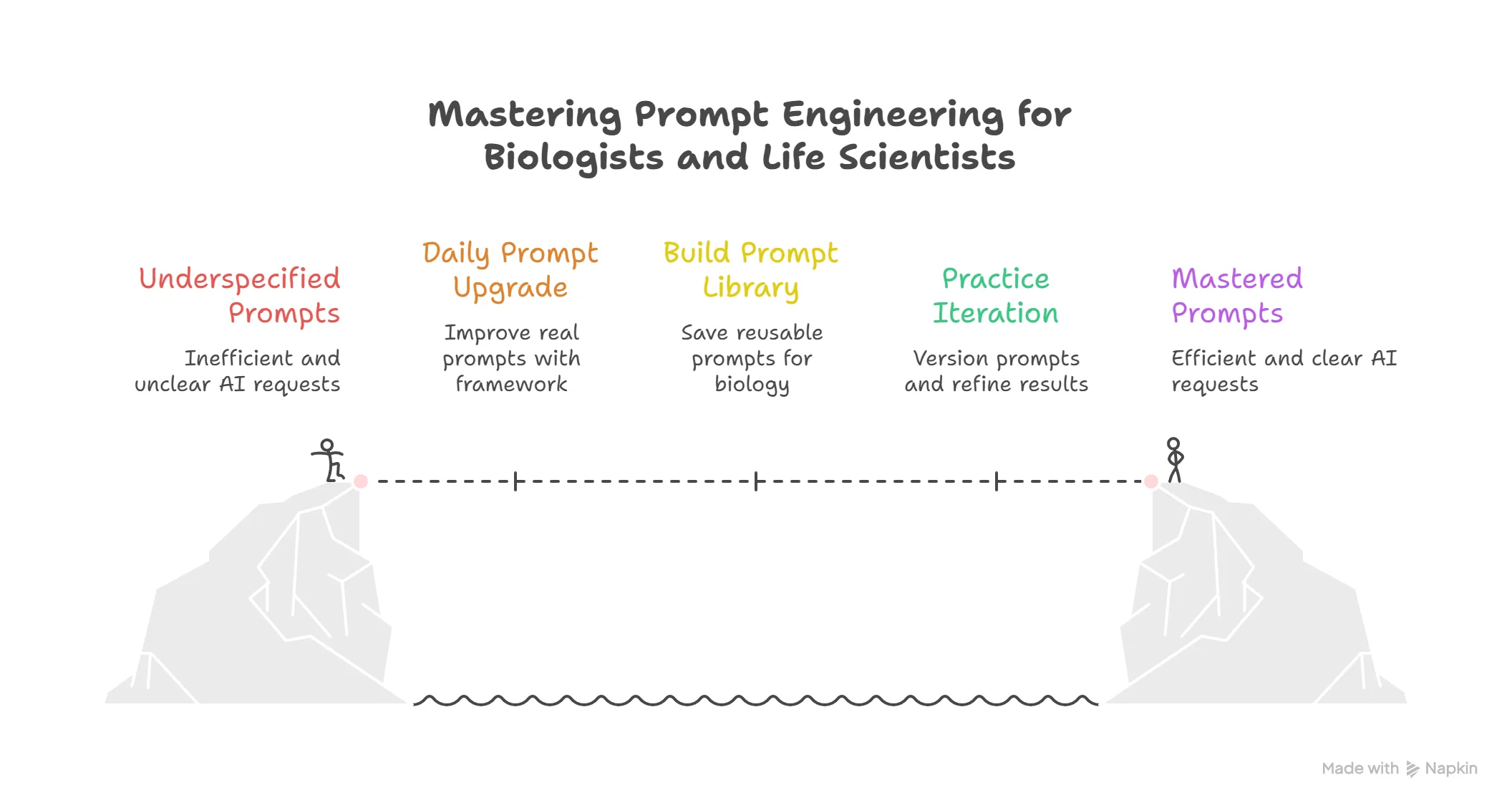
Here’s a simple three-step approach you can start using today to learn prompt engineering for biology.
Step 1: Upgrade One Real Prompt Per Day (Week 1)
What to do: Each day, take one prompt you were already going to use and upgrade it using the 6-element framework. Then compare the output before and after.
No artificial exercises. No “practice prompts.”
Only real biology work.
How to do it (progressively):
- Start with your original prompt
- Add Role + Task
- Add a clear Goal
- Add relevant Context
- Add Constraints
- Specify the Output format
You don’t need all six on day one. Build up to them.
Why this works: You’re not adding extra work, you’re improving work you’re already doing. The feedback is immediate, and patterns start to click fast. After a few days, you’ll feel when a prompt is underspecified.
Action item:
Do this once per day for 7 days in ChatGPT, Claude, or whatever tool you use.
Step 2: Build Your Prompt Library (Week 2)
What to do:
Create a simple document (Notion, Google Docs, Obsidian, wherever you already work) and start saving your biology ai prompts that consistently give you good results.
Useful categories for biology professionals:
- Literature work (summaries, comparisons, hypothesis generation)
- Protocol documentation (SOP drafts, troubleshooting)
- Communication (emails, explanations, customer-facing text)
- Presentations (slides, speaker notes)
- Data interpretation (analysis explanations, visualization requests)
- Regulatory and compliance (reviews, structured drafts)
Start small: one solid biology prompt per category. Add more only when something proves reusable.
My approach:
I keep mine in Notion. If I use a prompt twice, it gets saved. After three months, I had 30+ prompts I reused constantly. Anthropic’s Claude also maintains a public prompt library with strong examples you can adapt for life science work.
Why it works: You stop reinventing prompts and start building an AI toolkit that compounds over time.
Step 3: Practice Iteration (Ongoing)
What to do:
Treat prompts the same way you treat protocols: version them.
Simple process:
- Prompt v1 → run → evaluate
- Prompt v2 → add constraints → better
- Prompt v3 → refine output format → even better
- Prompt v4 → keep and reuse
Keep short notes on what improved results and what made them worse. Over time, you’ll spot patterns for each task type.
Remember:
Scientists iterate everything, experiments, protocols, workflows (and yes, coffee routines). AI prompts for biology are no different.
Bonus Step: Ask AI to Improve Your Prompt (Shortcut)
What to do: Ask the AI to critique and improve your biology prompts.
Example:
“I’m a field application scientist. I need to explain flow cytometry compensation to cell biologists with limited flow experience. Here’s my current prompt: [paste prompt]. How can I make this clearer, more practical, and better suited to this audience?”
The key: Give AI context about YOUR role and audience.
Why it works: Fast feedback, often catches things you missed, learn from the suggestions.
Bonus Step: BioPrompt Studio
And of course feel free to use BioPrompt Studio to practice the 6-elements framework for life science prompt engineering, refine your thinking, and collect AI prompts for biology you can reuse across experiments, literature reviews, SOPs, and presentations.
Conclusion | From Knowing to Doing: Your Next Step with AI Prompts for Biology
By now, you’ve seen the full picture: the real difference between using AI and getting meaningful results from it isn’t access, models, or features. It’s knowing how to communicate clearly with these tools in a biology-first way.
That’s what prompt engineering for biology is in practice and the 6-element framework just makes that explicit:
- Role – who you’re speaking as
- Task – what needs to be done
- Goal – why it matters
- Context – what AI needs to know
- Constraints – what to include/exclude
- Output – how to structure it

This framework isn’t complicated, and it’s not theoretical. It mirrors how scientists already think: define perspective, clarify the task, state the goal, provide context, set boundaries, and decide what a usable result looks like.
When I started applying this consistently, the impact was immediate. On average, I recovered more than 10 hours per week, not by working harder, but by prompting better.
👉(BTW If you’re looking for practical software that works well with this framework, I’ve put together a curated list of 10 Essential Free AI Tools for Scientists I Can’t Work Without—the ones I actually use in my daily work).
And here’s my challenge to you: pick one task you’re already doing this week. A paper summary, an SOP draft, an explanation for a colleague, and run it once through the framework. Just once. Compare the result.
Over time, those small improvements compound. Your biology ai prompts get clearer. Your outputs get more reliable. AI stops feeling like a novelty and starts feeling like a real lab and workflow assistant.
The biology professionals who thrive in the next decade won’t be the ones who avoided AI, but the ones who learned how to use it well. And if you’ve made it this far, you’ve already taken the first step.
Let’s Keep the Conversation Going
I’m still learning, experimenting, and discovering new approaches every week. And I’d love to hear from you.
- 💬 Drop a comment below: What’s the hardest part of using AI in your biology work right now? Which of the six prompt elements do you think will make the biggest difference for you? Or have you tried prompt engineering for life science before and felt stuck? Share your experience in the comments. Chances are someone else is running into the same issue.
- 🔄 Share this post: If you know a bench scientist, field application specialist, regulatory or quality professional, or anyone in life sciences who’s curious about getting better results from AI, feel free to pass this article along. Better biology prompts benefit entire teams, not just individuals.
- 🚀Curious for more? Check out the rest of the blog for more stories on AI in biology and life sciences. Plenty more to explore!

- 📩Subscribe to the Curiosity Bloom newsletter: Get practical AI insights for biology professionals, tool reviews from the life science world, ready-to-use prompts, and yes, a bit of humor too—all straight to your inbox every two weeks.
Register now and receive BioPrompt Studio for free: a tool I designed specifically to help life scientists practice prompt engineering in a structured way. No fluff, just hands-on practice with real biology scenarios.
✅ Free | 📧 Every 2 weeks | 🔒 Unsubscribe anytime | 🎁 Free BioPrompt Studio access
Let’s learn this together. Grazie for reading and being part of this journey! 🌟
FAQ: Your AI Prompts for Biology Questions Answered
Can AI replace my scientific expertise when using good AI prompts for biology?
No, and that’s the whole point. Prompting doesn’t replace your expertise; it helps AI use it properly. AI doesn’t understand your experimental nuance, regulatory context, or application-specific constraints. You do. Good biology prompts simply communicate that knowledge more clearly. AI amplifies your expertise, it doesn’t substitute for it.
How do I know if my prompt for life science is “good enough” before running it?
Quick self-check:
- Could a smart colleague with no context deliver what you want from this prompt? If not, add context.
- Could AI give five very different “correct” answers? If yes, add constraints.
- Did you specify the output format? If not, you’re leaving results to chance.
These three checks catch most weak prompts.
Should I use the same biology prompts for ChatGPT and Claude, or are they different?
Yes! The 6-element framework works across tools. That said, models differ. My advice: build one solid prompt, test it on both, and note which works best for each task. Save that in your prompt library.
What if I work with proprietary data or confidential information?
Never paste sensitive data, proprietary protocols, customer info, or unpublished research into public AI tools. Instead, ask for general principles or frameworks. You’ll still get useful guidance without risking confidentiality. For truly sensitive work, use enterprise AI solutions with proper data governance.
How long does it actually take to get good at prompt engineering for life sciences?
You’ll notice improvement within a week. Real fluency takes about a month of regular use. In my experience: week 1 felt slow, week 2 showed time savings, week 3 I actively delegated tasks, and by week 4 I had 20+ saved prompts and was saving 10+ hours per week. Consistency beats intensity, one prompt a day is enough.