Skip to content

Introduction: Your PhD is More Than a Degree—It’s a Launchpad
Ciao a tutti! Giuseppe here, your friendly molecular biologist with a PhD under my belt and a few years in the industry trenches. If you’re wondering what PhD in biology careers look like—whether you’re deep into your PhD or just exploring your options—you’re in the right place.
Remember those moments of existential crisis in the lab? Maybe you’re experiencing them now, pipette in hand, wondering, “What am I doing with my life?” Or perhaps you’re staring at grad school applications, cursor blinking ominously, asking yourself, “Is pursuing a PhD really worth it?” Trust me, we’ve all been there.
So, whether you’re a fresh-faced undergrad, a battle-hardened PhD candidate, or somewhere in between, grab your favorite lab-safe beverage, and let’s dive into the diverse career landscape for biology PhDs. We’ll explore various sectors that are hungry for your skills, and then we’ll break down the smorgasbord of roles you could sink your teeth into.

From Lab Rat to Career Explorer: My PhD in Biology Adventure
Before we jump into the biology PhD career smorgasbord, let me share a bit of my own journey. I did my PhD in molecular biology, focusing on aging and age-related neurodegenerative diseases. When I started, I had about as much career direction as a mouse has life expectancy in a research laboratory.
I chose the PhD route partly because I love biology (duh!) and partly because I was curious about what it’s like running my own research project. Oh, and let’s be honest – it bought me some time to figure out what the heck I wanted to do with my life (still asking myself…).
I had no clue what I could do with a PhD when I started. Looking back, I strongly advise you to inform yourself about career opportunities in advance.
Here’s my tip: Don’t be like me. Start exploring your options early! And remember, while a PhD opens many doors, there are plenty of fantastic opportunities for biologists even without one.
Now, let’s first dive into the juiciest sectors where your hard-earned doctorate can land you!
Beyond the Lab: PhD in Biology Career Paths
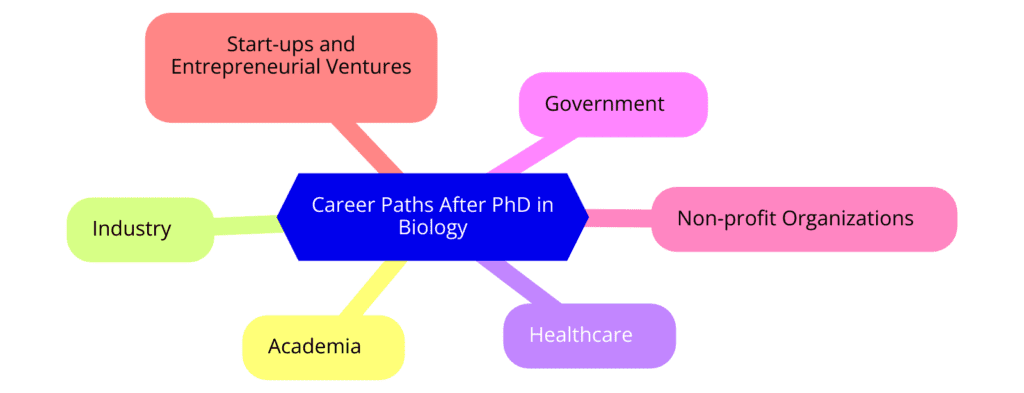
Academia: Is the Traditional Route Right for You?
For many biology PhD graduates, academia is the traditional career path—but what does that actually mean in terms of job opportunities?
- University: First, there’s the university route—teaching, research, and an endless battle for funding. If you dream of a tenure-track position, prepare for years of postdocs, publishing, and grant-writing. Not into that grind? Universities also hire lecturers, research scientists, and teaching faculty, so you can stay in academia without the pressure of chasing tenure.

- Research institutes: Then, we have research institutes, which are like academia but without the undergrads and mandatory teaching. Places like the Max Planck Institutes, NIH, and CNRS focus purely on research, offering positions for staff scientists, principal investigators (PIs), and research fellows. If you love doing science without the distractions of grading papers or explaining PCR to a room full of freshmen, this might be your ideal habitat.
- Public hospitals: Finally, there’s academic medical centers and university hospitals, where PhDs work in clinical research, biostatistics, or lab management, bridging the gap between science and medicine. It’s research with real-world impact—sometimes even life-saving.
Funding & Job Market Realities: How competitive is academia?
But here a tough reality check: According to a 2022 publication, in the biological sciences, a whopping 80% of fresh-graduated PhDs dive into the postdoc pool. However, in the United States, only about 10-21% of postdocs eventually secure tenure-track faculty positions (Denton et al., 2022). The academic world can be as competitive as a group of grad students fighting over the last slice of free pizza at a seminar.
But don’t despair! About 16.8% of biology PhD holders take on other academic roles like lecturers, research staff, teaching faculty, and scientific service (Lu et al., 2023).
And here’s a hot but obvious tip: a strong predoctoral publication record significantly boosts your chances of securing that coveted faculty position (Tregellas et al., 2018). So, publish or perish, as they say!
Industry Careers: Where Biology Meets Biotechnology & Pharma
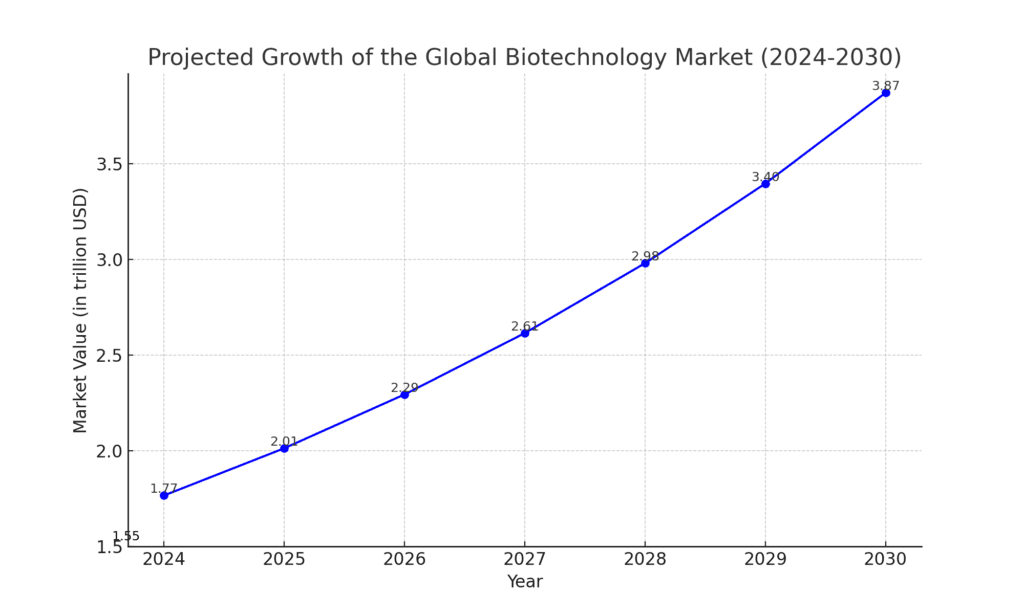
If academia feels like a petri dish that’s a bit too crowded, industry might be your jam. The biotech industry is booming faster than E. coli in a glucose-rich medium. According to a Grand View Research report (GrandViewResearch, 2023):
“The global biotechnology market was valued at USD 1.55 trillion in 2023 and is projected to grow at a compound annual growth rate (CAGR) of 13.96% from 2024 to 2030“
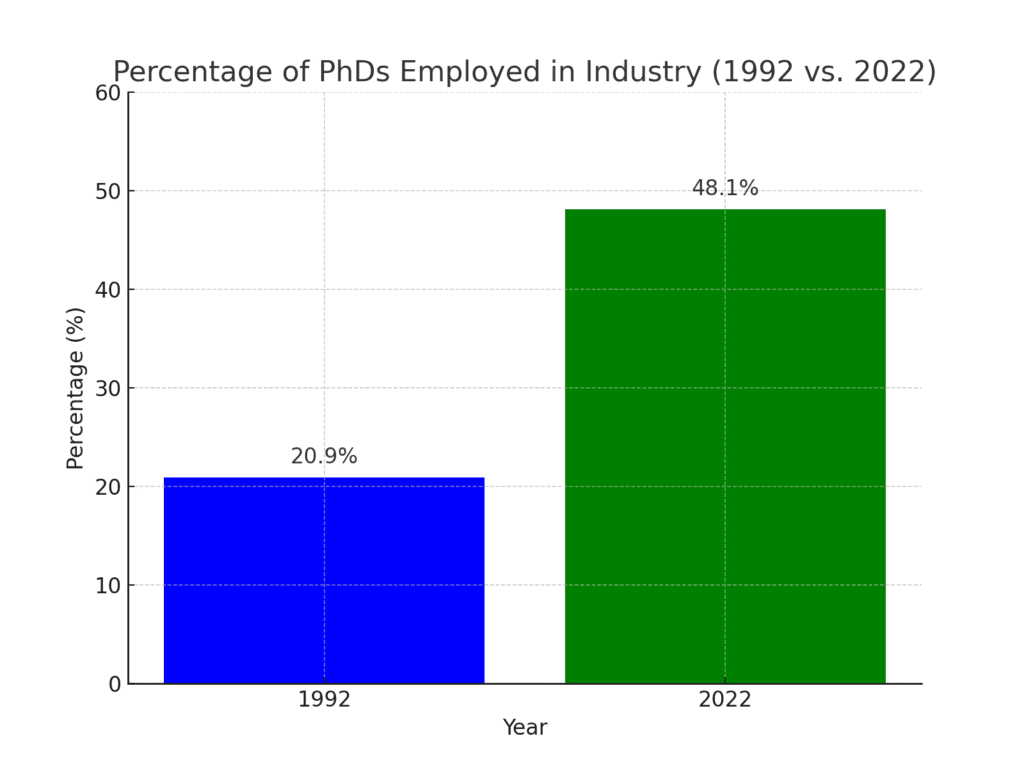
Here’s a juicy tidbit: Historical data shows a clear trend – an increasing share of PhDs has been gobbled up by industry over time, skyrocketing from a mere 20.9% in 1992 to a whopping 48.1% in 2022 (chronicle.com).
Biotech & Pharmaceutical Industry: Drug development, medical research, and more
The biotech and pharmaceutical industries are where scientific discoveries become real-world treatments, tools, and technologies. Whether it’s drug development, medical research, gene editing, or diagnostics, these industries thrive on innovation—and they need skilled PhDs to drive it forward.
Here’s a look at some key players in this ever-expanding sector:
- Pharmaceutical Companies: Because someone needs to finally cure the common cold (we’re still waiting, science). Whether it’s drug discovery, regulatory affairs, or clinical trials, pharma offers a range of career opportunities.
- Biotech Companies: This is where the magic happens—tweaking DNA, crafting cutting-edge therapies, and (if you’re lucky) edging closer to your childhood dream of recreating dinosaurs. Think gene editing, synthetic biology, and personalized medicine—these are some of the hottest areas driving innovation today.
- Agricultural & Environmental Biotech: For those who want to make tomatoes taste like actual tomatoes again, or develop crops that can survive climate change. Hopefully, it’s biology with a side of sustainability.
- Medical Devices & Diagnostics Companies: Because sometimes, the best way to solve a problem is to invent a gadget—think imaging technology, rapid diagnostics, and wearable health monitors.
- Food Science: Where you can literally have your cake and eat it too—by developing alternative proteins, nutritional supplements, and precision fermentation techniques (all in the name of science, of course).

Applications Support: Helping scientists use cutting-edge technology
Personal story time: After my PhD in biology, I took a leap into industry as an application specialist at a biotech company. It was like stepping into a whole new ecosystem – faster-paced, more structured, and (let’s be honest) with way better coffee than academia.
Unlike the slow grind of publishing and securing grants, industry work is results-driven, and that’s something I’ve come to appreciate. Here, I can see the impact of my work much sooner, rather than waiting years for a paper to (hopefully) get published.
Believe it or not, I made the leap straight from academia without extra certifications or internships. The toolkit I developed during my PhD—analytical thinking, creative problem-solving, and translating complex science to people who think CRISPR is a kitchen appliance—turned out to be exactly what I needed. If you’re nervous about making the move, remember: academia has already equipped you with plenty of valuable skills. The trick is learning how to package and present them effectively.
What about you? Not sure whether to choose academia or industry? If you want to know more about the eternal dilemma between these paths, check out this post:
Healthcare & Clinical Research: Where Biology Saves Lives
Imagine using your PhD skills to directly improve patient outcomes. In the healthcare sector, your expertise plays a critical role in advancing medical treatments, diagnosing diseases, and ensuring patient safety. From developing cutting-edge diagnostic tests to overseeing clinical trials for new therapies, healthcare offers a wide range of opportunities for biology PhDs.
Where Can You Work?
- Hospitals and Medical Centers: Ever dreamed of being on Grey’s Anatomy, but with less drama and more actual science? Hospitals and university medical centers offer research roles where you can contribute to clinical studies, translational medicine, and patient-centered research.
- Clinical Laboratories: Remember those hours perfecting your pipetting skills? In clinical labs, you’ll put them to use analyzing patient samples, developing new diagnostic tools, and ensuring test accuracy—real-world impact.
- Clinical Trials & Research Organizations: If you’re interested in bridging laboratory research with real-world treatments, clinical trials might be your calling. Whether working in hospitals, pharmaceutical companies, or Contract Research Organizations (CROs), PhDs play a vital role in designing studies, monitoring trials, and ensuring regulatory compliance to bring new drugs and therapies to market.
Government & Policy: Biology at the Service of Society (and Navigating Bureaucracy)
For those who want to make an impact on a national scale, government roles are like the mitochondria of the career world – they power everything! Working in government is like being part of a giant, nationwide experiment. Whether you’re shaping science policy, overseeing public health initiatives, or working in regulatory affairs, your expertise can influence the future of research, medicine, and environmental protection.
Where can you make a difference?
- Federal Research Agencies: Think NIH, CDC, or NSF—places where scientists tackle the world’s biggest health and environmental challenges, backed by government funding.
- Public Health Organizations: Because pandemics don’t solve themselves (looking at you, 2020). Your PhD can help shape disease prevention strategies, vaccine rollouts, and health policy decisions.
- Regulatory Bodies: Someone’s got to keep an eye on drug safety, environmental regulations, and food standards—that could be you! Agencies like the FDA, EMA, and EPA ensure scientific advancements are safe and effective.
Based on data from the Survey of Doctorate Recipients (SDR), the government is one of the career paths science PhDs pursue (forbes). It might not be the largest share of the job market, but it definitely plays a role!
Non-Profits & Conservation: Making an Impact Beyond the Lab
Want to use your PhD to make the world a better place while still paying rent? Non-profits and conservation organizations offer meaningful (and often mission-driven) career opportunities.
- Research Foundations: Organizations funding rare disease research, cancer treatments, and public health initiatives—where the science matters more than the profits.
- Conservation & Environmental Groups: Someone needs to speak for the trees (and the bees, and the seas)—whether it’s biodiversity research, climate change mitigation, or habitat restoration.
- Global Health Organizations: From disease eradication to improving access to healthcare, global non-profits rely on scientific expertise to drive change (think WHO, Gates Foundation, Médecins Sans Frontières).
Start-ups and Entrepreneurship: Be Your Own Boss (of Stress)
For those who like taking risks, thinking outside the box, and wearing multiple hats, the startup world can be an exciting (if slightly chaotic) career path. Whether you launch your own biotech company or become a consultant, there are plenty of ways to monetize your scientific expertise.
- Biotech Startups: Where your lab bench doubles as a pitch deck and your experiments are fueled by venture capital and caffeine. From CRISPR-based therapies to synthetic biology, startups are pushing the boundaries of innovation.
- Scientific Consulting: If you’d rather sell your expertise than run a business, consulting firms (or freelance consulting) let you advise biotech, pharma, and government agencies on strategy, R&D, and regulatory matters.
Did you know that, in the U.S., a significant proportion of PhD graduates, including life sciences, are involved in startups? Specifically, a recent graduate is twice as likely as their professor to start a business within three years of graduation (Åstebro, Bazzazian, & Braguinsky, 2011). That’s right, PhDs are becoming the new rock stars of the business world!
Job Market Trends: The Evolving World of Science Careers
Before we zoom in on the specific paths you can take with a biology PhD, it’s worth stepping back to see the broader landscape. Career opportunities for biology PhDs are shifting rapidly—kind of like a chameleon at a rave. Let’s have a look:
- Academic Dreams vs. Reality: Remember that stat about less than 25% of bio PhDs landing tenure-track positions? Well, it gets more interesting. Entry into academic principal investigator positions has been decreasing over time (Lu et al., 2023). It’s like musical chairs, but with lab coats. This doesn’t mean academia is dead – far from it! But it does mean that competition is fierce, and many PhDs are finding fulfilling careers outside the ivory tower.
- Industry’s Siren Call: On the flip side, science-related non-research and industry positions have been on the rise (Lu et al., 2023). Industry is like the cool kid at the career party, and everyone wants to hang out. Companies are recognizing the value of PhD-level expertise, not just in R&D, but in a variety of roles. From big pharma to small biotech, opportunities abound for those willing to make the leap from academia to industry.
- Entrepreneurial Spirit: Remember that PhD grads are more likely to start their own companies? That’s part of a larger trend. PhDs are increasingly seeing themselves as not just scientists, but innovators and problem-solvers in the broader economy. PhDs are carving out their own niches in the business world.
- Interdisciplinary is In: The lines between biology and other fields are blurring. From bio-engineering to environmental policy, hybrid roles are popping up like mushrooms after rain. Don’t be surprised if you find yourself collaborating with computer scientists, engineers, or even social scientists. The ability to bridge disciplines is becoming increasingly valuable.
- Communication is Key: With the growing need for science communication (thanks, misinformation!), roles in this area are expected to grow due to the increasing demand for effective communication of complex information, including scientific content (Fischhoff, et al., 2013). Whether it’s explaining complex science to the public, writing for scientific journals, or developing educational content, there’s a growing demand for those who can translate scientific jargon into plain English.
- Career Shifts: Plot twist! Studies show that a significant number of PhD graduates are making a complete change and moving into non-science-related roles. For example, a study on the employment of PhDs found that a considerable number of graduates are pursuing careers outside of traditional research roles, exploring opportunities in diverse sectors like business and public service (Sinche et al., 2017). These brave souls are taking their problem-solving skills and analytical minds into fields like business, law, or even the arts. Who says you can’t be a scientist-turned-novelist or a biologist-turned-banker? It’s a small but mighty trend that proves your PhD is not just a ticket to the lab but something much more versatile.

So, what does this all mean for you, dear PhD holder? It means that while the traditional academic path might be narrowing, a whole world of opportunities is opening up. It’s like evolution in action – adapt, and you’ll thrive!
Now, let’s explore some of the myriad of roles you could play in this brave new world of biology careers. Remember, these roles often span multiple sectors, so keep your mind as open as DNA during transcription!
Choosing the Right Career Path: What Works for You?
A. Research-focused Roles: For Those Who Live and Breathe Experiments
- Postdoctoral Researcher: Ah, the postdoc – PhD upgraded version, with a better pay (hopefully). As a postdoc, you’ll continue to play in the lab, but with more independence than a PhD student. It’s a great way to beef up your publication record, learn new techniques, and position yourself for a permanent research gig.

Let’s get real: Postdoc life isn’t just about chasing big discoveries and imagining your Nobel acceptance speech. Recent research has highlighted the very real challenges early-career scientists often face in these roles.
Postdoct typically spans 1 to 5 years, creating a landscape of temporary employment that can be as unstable as a petri dish tower. This lack of permanence can significantly increase stress and anxiety about future career prospects among postdocs (Denton et al., 2022). But don’t let this scare you off – a postdoc can also be a fantastic experience, offering unparalleled opportunities to dive deep into research!
- Lab Manager: As a lab manager, you’ll be the glue that holds a research group together. You’ll juggle budgets, maintain equipment, and ensure everyone follows safety protocols (no, you can’t recreate Jurassic Park in the lab, Karen). It’s a great role if you enjoy both the technical and organizational aspects of science. You’ll need diplomacy skills to manage researchers (who can sometimes have, shall we say, strong personalities), and the ability to juggle multiple priorities.
- Principal Investigator/Lead Researcher: The boss of the lab, the captain of the ship, the Dumbledore of the research world. You’ll lead your own research team, secure funding, and try to remember everyone’s names. It’s not for the faint of heart, but hey, you get your name first on the papers!
Just keep in mind, these positions are becoming rarer unicorns in academia. According to Lu et al., entry into academic PI positions has decreased over time, while industry and non-research roles are on the rise (Lu et al., 2023). So, sharpen those grant-writing skills and prepare for some fierce competition!
B. Product Development and Management: Turning Science into Solutions
- Product Manager: Ever wanted to be the bridge between science and the market? As a product manager, you’ll oversee the development of new products from concept to launch. It’s like being a scientific polyglot, speaking the languages of researchers, marketers, and customers alike. Get ready to juggle more balls than a circus performer!
- Research and Development Specialist: R&D specialists are the wizards of the biotech world, conjuring up new products and improving existing ones. It’s a role that requires creativity, technical expertise, and the ability to see the big picture. Plus, you get to play with cool toys – I mean, cutting-edge equipment – all day.
- Project Manager: In the life sciences world, project managers are like conductors—bringing together experiments, deadlines, and resources into one coordinated performance. You’ll oversee teams of researchers, keep an eye on the budget, and make sure everything stays on track. It’s a role that demands sharp organizational skills, clear communication across different groups, and a strategic mindset.
C. Technical and Applications Support: The Science Whisperers
- Technical Support Specialist: Helping others use fancy equipment without breaking it. You’ll need a deep understanding of complex scientific instruments and the patience of a saint to explain things to frustrated scientists. It’s like being a tech-savvy therapist for both machines and humans.

- Applications Scientist: Remember that time you had to explain your research to your non-scientist friends at a party? As an applications scientist, you’ll be doing that professionally. You’ll demonstrate products, train customers, and sometimes even collaborate on developing new applications. It’s a great way to stay close to cutting-edge science while honing your communication skills.
Fun fact: This was actually my career path! I jumped straight from academia into industry after my PhD, landing a job as an Applications Scientist at a biotech company—no extra courses, no postdocs, just my PhD skills and a willingness to adapt. For me, it was the perfect mix of scientific expertise and real-world impact. And who knew that years of making PowerPoint slides for lab meetings would turn out to be one of my most useful skills?
D. Clinical Research: Where Biology Meets Medicine
- Clinical Research Associate (CRA): If you love science but also have a passion for paperwork (hey, no judgment), this might be your calling. As a CRA, you’ll be the guardian of good clinical practice, ensuring trials are conducted ethically and scientifically. Just remember, the only thing more important than your clipboard is your coffee supply.
- Clinical Trial Manager: Ever tried to organize a surprise party where nothing goes as planned? Welcome to the world of clinical trial management! You’ll oversee all aspects of clinical trials, from planning and budgeting to coordinating with regulatory bodies. Pro tip: develop a zen-like calm or a really good poker face – you’ll need both.
Fun fact: The global clinical trials market was worth a whopping $80.7 billion in 2023—and it’s expected to keep growing steadily at a 6.49% annual rate through 2030 (Grand View Research, 2023). That’s a whole lot of lab coats and data sheets!
E. Business and Strategy: Science Meets Savvy
- Consultant: Remember those problem-solving skills you honed during your PhD? As a consultant, you’ll use them to help companies tackle complex issues. It’s perfect for those who love variety and enjoy translating their scientific knowledge into business insights. Just be prepared for lots of PowerPoint presentations and the occasional need to explain PCR to a room full of MBAs.

- Business Development Manager: If you’ve got a knack for spotting opportunities (like finding that one working pipette in a drawer full of duds), this role might be for you. You’ll be the bridge between science and business, identifying potential partnerships or acquisition targets. Just don’t be surprised if your dreams start featuring dollar signs instead of DNA helices.
- Venture Capitalist: Ever dreamed of playing with big money in the world of biotech? As a VC specializing in life sciences, you’ll evaluate startups and decide which ones to fund. It’s a high-risk, high-reward world where you could be funding the next breakthrough in cancer treatment or the future of sustainable agriculture.
F. Sales and Marketing: Selling Science (No Hocus Pocus Required)
- Sales Representative: If you can convince your PI to buy that fancy new microscope, you might have a future in technical sales. You’ll use your scientific know-how to help customers find the right solutions. Just remember, in this field, the customer is always right… except when they’re trying to use a centrifuge as a blender.
- Medical Science Liaison: Ever wished you could travel the world talking about science? As an MSL, you’ll be the go-to scientific expert for healthcare providers, sharing information about your company’s products and gathering insights from the field. Think of it as being a scientific diplomat. Pro tip: Learn to explain complex scientific concepts while jet-lagged. It’s a superpower in this role.
- Marketing Manager for Scientific Products: Think you can make pipettes sexy? As a marketing manager, you’ll use your scientific background to create compelling marketing strategies for technical products. It’s like being a scientific storyteller, crafting narratives that show how your company’s latest tool will revolutionize research.
G. Regulatory and Legal: Keeping Science Safe and Sound
- Regulatory Affairs Specialist: If you love science and have a secret passion for bureaucracy (everyone has something weird!), this might be your calling. You’ll navigate the labyrinth of scientific regulations, ensuring new products comply with complex requirements. Who knew all those hours organizing your sock drawer would finally pay off?

- Quality Control Analyst: Remember that satisfaction of getting a perfect gel? As a QC analyst, you’ll chase that feeling every day, ensuring products meet rigorous quality standards. Warning: May cause compulsive straightening of picture frames and alphabetizing of spice racks (QC or OCD?).
- Patent Agent/Attorney: Ever dreamed of protecting the next big scientific breakthrough? With some extra qualifications, you could become a patent agent or attorney, using your scientific expertise to help inventors protect their intellectual property. Finally, a job where being pedantic is actually a virtue!
H. Communication and Education: Spreading the Gospel of Science
- Science Writer/Journalist: If you’ve got a knack for explaining complex concepts (and let’s face it, after years of explaining your research to confused family members, you probably do), science writing might be for you. You’ll be the bridge between the world of research and the general public, turning data and experiments into narratives that captivate and inform.
- Medical Writer: Remember those dense scientific papers you had to wade through during your PhD? As a medical writer, you’ll be on the other side, creating clear, concise documents for healthcare professionals and regulatory bodies. Your superpower? Turning jargon into plain English faster than a grad student chugging coffee before a deadline.
- Science Educator/Outreach Coordinator: If you’ve ever dreamed of inspiring the next generation of scientists (or at least making sure they know the difference between mitosis and meiosis), this could be your path. You’ll develop programs to engage students and the public with science.
I. Data and Computational Roles: Biology’s Digital Frontier
- Bioinformatician: If you love both pipettes and pixels, bioinformatics might be your jam. You’ll use computational tools to analyze biological data, turning big data into big discoveries. Just remember, as a bioinformatician, you’ll be the ultimate science nerd – the only person who gets excited about both DNA sequences and SQL sequences!

- Data Scientist in Biological Contexts: Got a thing for statistics and a passion for biology? As a data scientist, you’ll apply statistical and machine learning techniques to biological problems. Side effects may include seeing patterns in your breakfast cereal and trying to calculate the p-value of your cat’s behavior.
- Computational Biologist: If you’ve ever dreamed of running experiments without getting your hands dirty, computational biology might be for you. You’ll develop models and algorithms to understand biological systems. Perfect for those who prefer their lab coats pristine and their experiments in silico.
Insider tip: If you don’t break into a cold sweat at the sight of a command line, this might be your arena. As biology becomes increasingly data-driven, careers in bioinformatics and data science are heating up—faster than a PCR machine hitting 98°C. The bioinformatics industry was valued at a hefty $12.56 billion in 2022 and is projected to skyrocket to $38.79 billion by 2030 (Pande, 2023), with a compound annual growth rate (CAGR) of 15.5% between 2023 and 2030.
J. Policy and Administration: The Backstage Heroes of Science
- Science Policy Advisor: Ever watched politicians discuss science and thought, “I could do better than that”? As a science policy advisor, you’ll bridge the gap between the world of research and the world of policy. Bonus skill: Explaining complex scientific concepts using sports metaphors and pop culture references.
- Research Administrator: If you’ve got a knack for organization and a passion for science, research administration might be for you. You’ll manage the business side of science, handling budgets, personnel issues, and institutional policies.
- Grant Manager/Writer: Remember the thrill of securing your first research grant? As a grant manager or writer, you’ll chase that high professionally, helping researchers turn their ideas into funded projects.

Conclusion: Your PhD is Just the Beginning
Whew! That was quite a journey through the career jungle, wasn’t it? And these are just some examples of most common positions for biology PhDs! From the hallowed halls of academia to the bustling world of industry, and everywhere in between, your biology PhD is like a Swiss Army knife of career possibilities.
Remember, the skills you’ve gained during your PhD – critical thinking, problem-solving, data analysis, crying silently in the supply closet – are incredibly valuable in a wide range of fields. You’re not just a scientist; you’re a highly trained professional with a unique set of skills that can be applied in countless ways.
As you embark on your post-PhD adventure, keep an open mind. The traditional academic path is still there if that’s your jam, but don’t be afraid to explore the road less traveled. Who knows? You might find your dream job in a place you never expected, as it was for me!
Before I let you go, here’s a little homework assignment:
- Reflect on what aspects of your PhD work you enjoyed most. Was it the research, the writing, the problem-solving?
- Explore some of the roles we’ve discussed that align with those interests.
- Reach out to people in those roles. LinkedIn is your friend!
- Consider what additional skills you might need to break into your chosen field.
Keep in mind—your career path will be just as original as the research you’ve done. Stay curious, keep growing, and make sure to enjoy the ride! And wherever your journey takes you, you’ll always have that one party trick: explaining (with scientific flair) why cloning dinosaurs is still off the table.
Stay Connected: Share, Comment & Keep Exploring with CuriosityBloom!
Want more insights on navigating the wild world of biology careers?
- 🚀 Stay tuned for more posts on Curiosity Bloom, where we dive deep into careers, biology, and the exciting world of scientific opportunities.
- 📩 Subscribe to the Curiosity Bloom newsletter for more career insights, job market trends, and tips tailored for biologists. Get fresh content straight to your inbox—no spam, just valuable advice!
If you found this post helpful, let’s keep the conversation going!
- 💬 Drop a comment below and share your thoughts—what career paths are you considering? Have you already made a transition from academia to industry? Your experience might inspire someone else!
- 🔄 Share this post (See “If you like to share” below) with friends, colleagues, or fellow PhD students who might be wondering about their next steps. Let’s help more biologists navigate their careers with confidence.
Your PhD is just the beginning—let’s explore the possibilities together!🌟
FAQ: Your Burning Questions, Answered!
Is it possible to return to academia after working in industry?
Absolutely! Many universities value industry experience. You might find yourself bringing a unique perspective back to the academic world.
How important are publications for non-academic careers?
While publications are the currency of academia, they’re often less crucial in other sectors. However, they can demonstrate your expertise and research skills, which are valuable in many roles.
Can I still do research if I don’t stay in academia?
Definitely! Many industry and government positions involve cutting-edge research. You might find yourself with even more resources at your disposal!
Do I need a postdoc to be successful outside of academia?
Not necessarily! While postdocs can provide valuable experience, many industry and non-academic roles value the skills you’ve already gained during your PhD. It’s all about how you market yourself!
How do I transition from academia to industry?
Start by identifying transferable skills, networking with industry professionals, and considering internships or collaborative projects with companies. Many companies value academic expertise – you just need to learn to speak their language!