Skip to content
Introduction: Why AI Won’t Replace Biologists (But Will Transform How We Work)
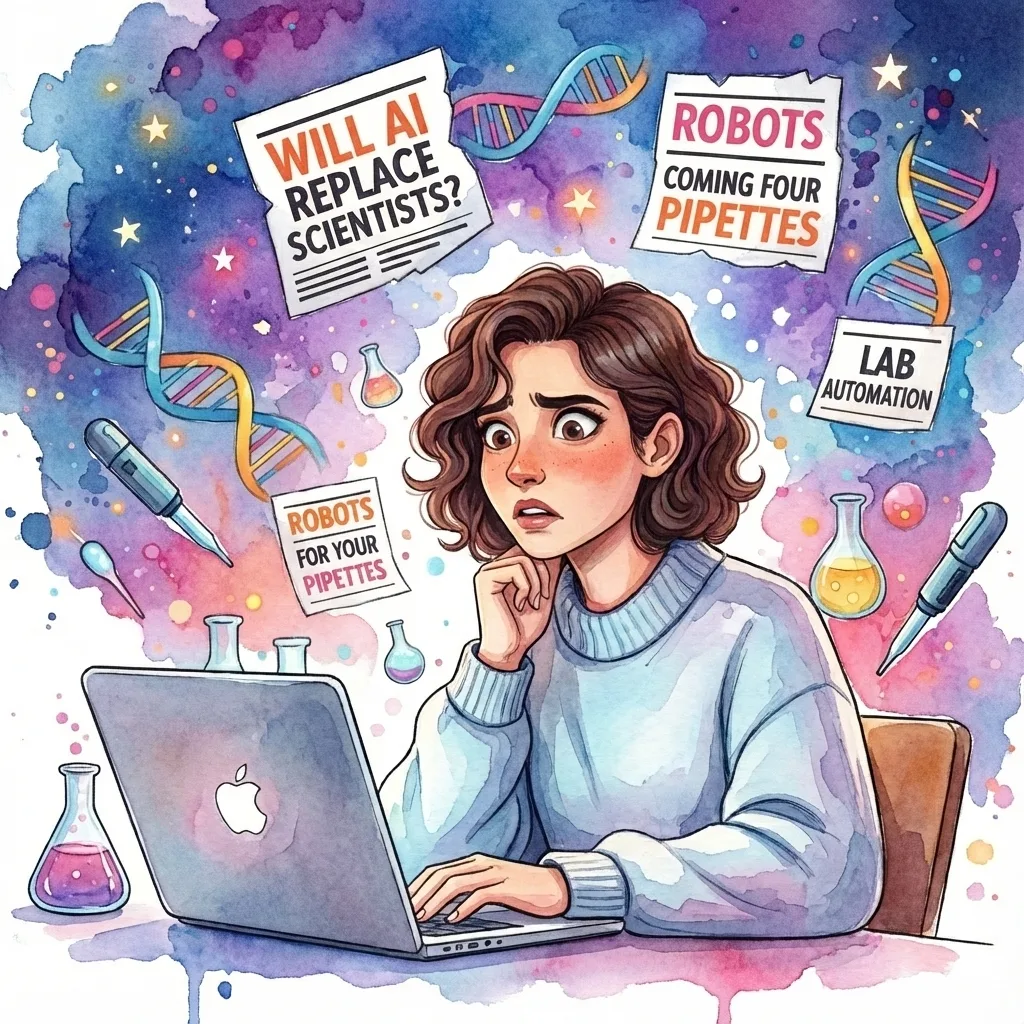
Ciao a tutti, Giuseppe here! If you work anywhere in life sciences, you’ve probably seen the headlines: “AI will replace scientists”, “Lab jobs are doomed”, or my personal favorite, “Robots are coming for your pipettes.”
No surprise many biologists quietly type “will AI replace scientists?” into Google at 2 a.m. (Right between “Is my experiment ruined?” and “How much sleep do humans actually need?”)
The anxiety is real, but it’s also largely misplaced. When you zoom out beyond clickbait, a very different picture emerges. Market data, real-world case studies, and current AI limitations all point in the same direction: AI is not on track to replace biologists or life scientists. It’s changing how we work, not whether we’re needed.
In this post, I’ll walk you through research-backed evidence, examples from pharma and biotech, and concrete case studies that show AI as an accelerator, not a replacement. We’ll look beyond researchers at the bench and include everyone whose work touches biology.
By the end, I want you to see the real question is no longer “will AI replace biologists or will AI replace life scientists?” The real question is: Will you be the person replaced by AI, or the person using AI to set the pace of discovery?
The Paradigm Shift: From Replacement Fear to Collaboration
In just a few years, the conversation has shifted from “Will AI replace scientists?” to a much healthier question: “How do we work with AI?” (and hopefully won’t turn into the really scary one: “Wait… can we still work?”).
You’ve probably heard NVIDIA CEO Jensen Huang’s bold claim that biology is becoming more like engineering. Something that improves exponentially once processes become systematic. Sounds exciting… and a bit terrifying.
“For the first time in human history, biology has the opportunity to be engineering not science. When something becomes engineering not science, it becomes exponentially improving”.
But here’s the key nuance: “biology as engineering” doesn’t mean biologists become obsolete. It means our work becomes more structured, scalable, and tool-assisted, as long as domain experts stay in the driver’s seat. (Maybe someone should tell him we are still debugging experiments with sticky tape and prayers).
Across pharma, biotech, and genomics, the consensus is consistent: AI augments biological expertise; it doesn’t replace it. Hence the now-familiar line: “AI won’t replace biologists, but biologists who use AI will replace those who don’t.” Dramatic? Sure. Wrong? Not really.
The Wellcome Sanger Institute makes it even clearer:
“AI should be viewed as a collaborative tool, providing insights that complement human expertise. With this in mind, it is clear that researchers need the relevant skills to work with AI to support innovation” (sangerinstitute.ac.uk).
Translation: the future isn’t “humans vs. AI.” It’s humans + AI.
My Lived Shift From Skeptic to Daily AI User
As a molecular biologist turned Field Application Specialist, I never saw myself as “an AI person.” I wasn’t a coder, didn’t know a bit of machine learning, and assumed these tools belonged to the bioinformaticians – those mysterious half-human, half-chair creatures who speak Python and whom nobody has ever seen standing.
Then I started using AI for small things: drafting emails, summarizing papers, mapping workflows, and before long I was building automations that genuinely support my day-to-day work.
AI didn’t change who I am as a biologist. It just removed friction. I still make every decision, add the context, and check everything. My scientific thinking didn’t get replaced, it got more space to breathe.
👉If you are curious about some very simple AI tools I use daily for basic tasks, check out this article: 10 Essential Free AI Tools for Scientists I Can’t Work Without. It’s a gentle on-ramp, no coding required.
Why AI Can’t Replace Biologists (Even If It Tries)
The belief that AI will simply automate biology reveals a misunderstanding of both fields. Biology remains stubbornly unpredictable (the kind of discipline where you can repeat the exact same protocol twice and get two results and three existential crises), and today’s AI excels mainly at pattern recognition, not scientific reasoning.
Artificial Intelligence still struggles with tasks core to scientific discovery, such as:
- Experimental design in uncertain domains: Choosing what to test when the outcome is genuinely unknown
- Spotting anomalies: Recognizing an unexpected result that matters rather than dismissing it as noise
- Generating hypotheses from first principles: Not just remixing existing ideas but proposing truly novel ones
- Interpreting weird failures: Understanding why something didn’t work and turning that into insight

A 2025 Nature Scientific Reports study spells this out bluntly:
GenAI can assist, accelerate, and refine, but it cannot independently perform scientific discovery or generate genuinely original hypotheses.
And anyone who uses AI daily knows this firsthand. I’ve had models confidently invent products, hallucinate papers, and give spotless, but totally wrong, answers. Helpful? Yes. Autonomous scientist? Absolutely not.
AI is the over-enthusiastic intern of biology: fast, clever, surprisingly capable, but nowhere near ready to run the lab alone.
If a system can’t autonomously design, interpret, and redirect real experiments, science isn’t going anywhere. It’s just evolving, with AI as a powerful collaborator, not a replacement. And even if it ever did become an autonomous scientist, it would still need a human to fix the incubator someone unplugged to charge their phone.
👉(BTW if you’re curious about how AI is reshaping biology careers, take a look at this post: AI Impact on Biology Jobs: Thriving in a Changing Landscape.)
The Market Reality: Skills Gap Proves Expertise Is More Valuable Than Ever
If AI were truly on the verge of replacing scientists, you’d expect hiring for biologists to be collapsing. Instead, there’s a critical shortage of people who understand both biology and AI.
This isn’t theory; it’s what pharma and biotech hiring data are screaming right now.
The 70% Problem: Industry Desperately Needs “AI Translators”
A recent analysis of 2024–2025 pharma hiring trends found something striking:
- 49% of pharma professionals say lack of AI skills is the biggest barrier to digital transformation.
- 44% of life-science R&D teams report the same.
- And ~70% of pharma hiring managers struggle to find candidates who combine deep domain knowledge with AI literacy.

That’s not a small mismatch. That’s a structural gap. (HR calls it “a hiring challenge.” Scientists call it “Tuesday.”)
These hybrid experts are often called “AI translators”: people who understand biology deeply and can judge whether an AI solution is useful, safe, and realistic in the real world.
If scientists were becoming obsolete, companies wouldn’t be desperately searching for more of them with this exact blend of skills.
The signal is obvious: as AI tools spread, biological expertise becomes more valuable, not less. Anyone can buy an AI model. Very few can apply it responsibly to real biology.
I see this constantly when I visit customers. Some brilliant scientists hesitate to touch AI; others are already using tools like ChatGPT or Claude to automate reporting, analyze literature, or even generate code scaffolds. Meanwhile, a third group still thinks “the cloud” is just where their data goes to die.
The difference isn’t intelligence, it’s exposure and confidence.
And that’s precisely why AI is creating new opportunities for biologists instead of eliminating them.
Big Pharma’s Response: Upskilling, Not Replacing
Across Johnson & Johnson, Novartis, Bayer, and other major players, the pattern is consistent: they’re training tens of thousands of existing employees in AI-related skills (intuitionlabs)
This is a strategic choice. Instead of hiring a small army of external data scientists and hoping they magically understand biology, they’re:
- Investing in AI training for scientist teams
- Building internal academies and AI bootcamps
- Encouraging cross-functional projects where domain experts and data scientists co-own outcomes
Why? Because domain expertise + AI literacy creates far more value than AI expertise alone.
If AI were truly “replacing” scientists, companies would be quietly shrinking their scientific workforce and replacing them with AI specialists. Instead, they’re betting heavily on AI-literate biologists.

The job market isn’t disappearing. It’s evolving.
Next, let’s look at real case studies.
Real-World Case Studies: AI as Accelerator, Not Replacement
If you want to know whether AI will replace scientists, you can’t just read predictions. You have to look at how AI is actually being used in real projects.
Two of the most cited examples, Insilico Medicine and BioNTech, show the same pattern: AI speeds things up, but humans still run the science.
Case Study 1: Insilico Medicine’s AI-Designed Drug
Insilico’s idiopathic pulmonary fibrosis program is often positioned as the poster child for “AI-discovered drugs.” The reality: AI accelerated the pipeline, but humans led every critical step (insilico.com).
AI helped by:
- finding a novel target in weeks
- generating and ranking candidate molecules
- compressing the computational design cycle
Humans handled:
- synthesis, medicinal chemistry, and biological validation
- in vitro and in vivo studies
- clinical trial design and execution
- safety, regulatory strategy, and decision-making
The result: The program completed the path from target discovery initiation to the start of the Phase I clinical trial in under 30 months, instead of the typical 3–6 years, with major cost savings.
But it wasn’t “AI invented a drug.” It was AI removed bottlenecks; humans made the science real. In other words, humans handled everything wet, messy, regulated, or likely to explode, which is to say, a big part of biology.
Case Study 2: How AI Helped BioNTech Beat the Clock
The mRNA vaccines of 2020–2021 are often used as Exhibit A in “AI is revolutionizing biology” narratives (intuitionlabs).
During COVID-19 vaccine development, AI helped BioNTech and partners:
- analyze viral genomes in hours, not months
- screen mRNA designs in silico
- predict expression, immunogenicity, and codon optimization
Humans still needed to:
- design and run all immunology experiments
- manufacture mRNA and LNPs
- perform animal and clinical studies
- manage global regulatory and manufacturing decisions
AI compressed the computational stages; human teams handled every biological and clinical step.

The Takeaway
Across both examples, the formula is the same:
AI + human expertise = accelerated innovation.
Remove either one, and progress stalls.
Remove both, and you get a grant proposal…
And this applies across the Life Sciences, from research to business, customer-facing, and regulatory roles. Anywhere your scientific expertise still makes the difference.
So if AI isn’t pushing scientists out of the lab, what makes human expertise so irreplaceable?
What Makes Human Scientists Irreplaceable
If you’re still wondering “will AI replace biologists someday?”, the strongest reasons it won’t are not emotional. They’re cognitive and structural. Biology needs human capabilities that current AI simply can’t replicate.
1. Creative Intuition and Scientific Breakthroughs
Major discoveries rarely come from extending existing patterns. They come from intuition, spotting odd results, asking unconventional questions, or following a hunch before there’s hard evidence.

Take Kekulé, who apparently solved benzene’s structure not after pages of calculations, but after dreaming of a snake biting its own tail, resembling the molecule’s circular structure. Or Archimedes, whose best physics idea arrived mid-bath, proving once and for all that showers are underrated brainstorming tools.
These stories aren’t exaggerations, they highlight how creativity, intuition, and randomness drive scientific breakthroughs in ways no algorithm can emulate.
Current GenAI doesn’t work that way. The same Nature study on GenAI and scientific discovery concluded that these systems work well within known knowledge spaces but cannot make the kind of creative, counterintuitive leaps humans do.
In simple terms:
- AI is great at remixing what exists.
- Human scientists create what doesn’t yet exist.
2. The Complexity Barrier: Why Some Predictions Remain Hard
Another common belief is that AI limitations are just a temporary hardware or algorithm problem. “Give it more data and better models, and eventually it will out-predict us on everything.”
Biology strongly disagrees. Living systems operate across multiple interconnected scales:
- Molecules → Cells → Tissues → Organs → Organisms → Populations → Ecosystems
At each level, emergent properties appear that you can’t fully infer from the lower level. Even with perfect data, some behaviors remain fundamentally hard to predict. This is often called the complexity barrier. And that’s why it makes sense for me to jump three times on the right leg and wear the same lucky t-shirt before to run important experiments.
A few examples:
- Toxicity still resists prediction because it emerges from metabolism, immune response, and patient-specific factors.
- AlphaFold predicts structure well, but can’t account for modifications, cellular environments, or how proteins behave in real pathways.
- Patient variability remains a black box. Two similar profiles can react very differently to the same drug.
These aren’t temporary AI weaknesses. They’re intrinsic to complex systems, meaning human judgment and experimentation will always matter. Apparently, biology has a sense of humor and likes to troll even the best predictions.
3. Bias Recognition and Ethical Oversight
There’s another major reason we can’t hand science over to AI: bias.
Anthropologist Lisa Messeri warns that AI often creates “illusions of understanding” by appearing objective while reflecting the assumptions of those who built it (hallucinations-and-illusions-of-ai-in-science).
We need human scientists, especially diverse teams, to:
- ask ethical questions no algorithm can
- spot missing or skewed data
- question overconfident outputs
Without humans, AI doesn’t just fail to correct bias, it amplifies it.
4. The Human Elements Science Depends On
There’s also the everyday, human side of scientific work that no model can replace.
In my Field Application Specialist role, I’ve seen this over and over. Imagine this: I’m in a customer’s lab, mid-demo, and the instrument decides today is the day to throw an error message it has never shown before, just to remind me who’s really in charge. The customer looks at me; their experiment (and maybe their grant) depends on this working.
In that moment, what matters?

- Staying calm and reassuring them
- Quickly diagnosing what might be wrong
- Explaining what’s happening in a way that doesn’t trigger panic
- Building trust under pressure
No AI can walk into a stressed lab, understand the social dynamics, and guide people through uncertainty (though I wouldn’t mind if it tried).
Across life sciences, these quiet human skills hold entire projects together.
AI can do a lot. But trust, leadership, communication, and real-time judgment remain human territory.
What This Means for Your Career in Life Sciences
Let’s bring this down from “global trends” to your day-to-day reality. If AI isn’t here to replace you, but it is reshaping your work, how do you stay ahead?
The short version: your biological expertise has never been more valuable, if you pair it with AI skills.
Domain Expertise + AI Skills = Your Competitive Edge
AI tools are powerful, but they’re also context-hungry. Without good input and interpretation, they produce outputs that are generic at best, dangerous at worst.
That’s where you come in.
Your biology training is the filter that makes AI useful.
This is why the question “will AI replace scientists?” misses the point. AI without scientists is like a super-fast car with no driver and no idea where the road is.
And there’s some urgency here. A growing gap is forming between AI-literate scientists and those who still avoid these tools (some probably think GTP is just GPT pronounced by Yoda).
Early adopters are already:
- Automating repetitive tasks
- Synthesizing literature faster
- Communicating results more effectively
Those advantages compound over time.
Beyond Researchers: How AI Is Touching Every Life Sciences Role
This shift is not limited to R&D. Across the life sciences, AI is quietly reshaping roles like Clinical Affairs, Product Management, Sales, Customer Support, Regulatory Affairs. In short, anywhere humans were drowning in Excel sheets and PDFs.
In none of these areas is AI eliminating roles. It’s expanding what one person can handle.

In my own FAS work, AI is like a universal assistant. It helps me:
- Draft follow-up emails and training materials
- Summarize complex papers before a customer visit
- Turn scattered notes into structured action plans
- Automate ripetitive tasks
But it only works when I feed it good context: assay types, cell lines, experimental constraints, customer needs. Without that, the output is vague or just wrong.
That experience has made one thing very clear to me: the more biology you understand, the more powerful these tools become.
Action Steps: Building AI Fluency Without Becoming a Programmer
You do not need to become a software engineer to thrive here. But you do need basic AI literacy.
👉This is why I wrote about 5 “Non-Coding” AI Skills That Boost Your Biology Career.
The most important skills now are things like:
- asking the right questions
- evaluating data quality
- interpreting AI outputs
- knowing how to integrate AI in your work
If you want a practical roadmap, that post is your next step.
Final Thoughts: Your Biological Expertise Is Your AI Superpower
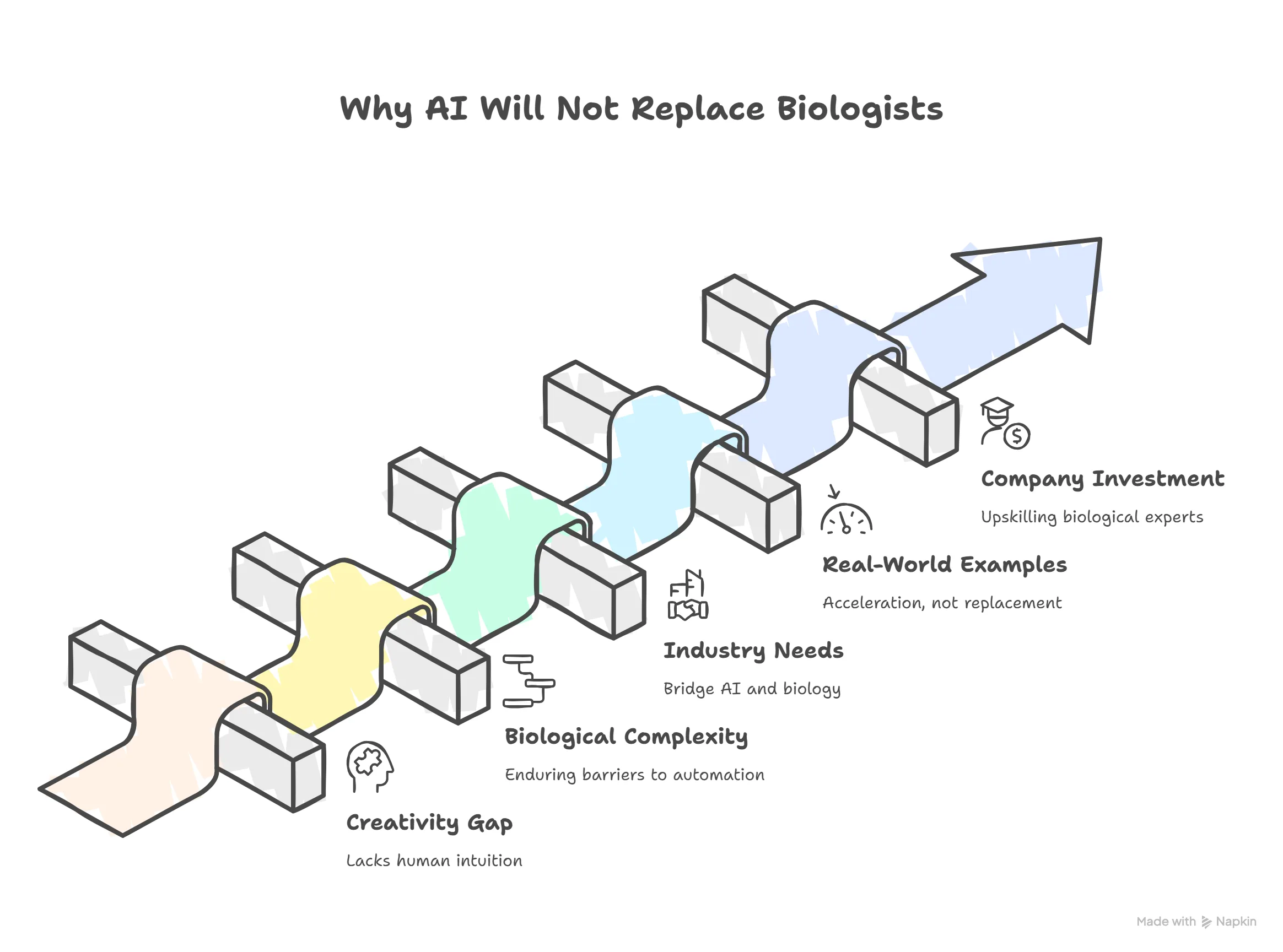
When you pull everything together, market data, real case studies, and the fundamental limitations of current AI, a consistent story emerges.
- AI cannot replicate human creativity, intuition, or deep contextual understanding.
- Biological complexity creates enduring barriers to full automation, especially in real-world function.
- Industry is hungry for scientists who can bridge AI and biology, not looking to swap one for the other.
- Real-world examples show acceleration of specific steps, not end-to-end replacement.
- Companies are investing billions in AI and simultaneously upskilling their biological experts to use it.
Put simply: we’re moving into an era of augmentation, not replacement.
That means this is arguably the best moment in history to be a biologist who’s willing to embrace AI. Your domain knowledge is the prerequisite for making these tools work. AI amplifies your expertise, it doesn’t erase it.
So maybe the question was never really “will AI replace scientists?” at all.
The real question is:
Will you be among the biologists who use AI to set the pace of discovery, or among those watching from the sidelines as the field evolves without them?
If you choose the first path, your biological training doesn’t become obsolete.
It becomes your superpower in an AI-augmented world.
Let’s Keep the Conversation Going
Are you a bench scientist, lab manager, FAS, product specialist, or bioinformatician wondering how AI fits your workflow? Are you already using tools at work, or still skeptical about where they add real value?
- 💬Drop a comment below: What’s one task you’d love to streamline with AI? What’s your biggest worry or roadblock? Your experience might help someone else in the same boat.
- 🔄Share this post (Buttons below): Know a biologist, clinical scientist, or life science colleague anxious about AI? Send this their way. Help them find clarity and practical next steps, not doom.
- 🚀Curious for more? Check out the rest of the blog for more stories on AI in biology and life sciences. Plenty more to explore!

- 📩Subscribe to the Curiosity Bloom newsletter: Get insights on AI in biology, practical how‑tos, and tool reviews from the life science world, with a pinch of humor straight to your inbox. Register now and receive BioPrompt Studio for free: a tool I designed to help life scientists practice prompt engineering.
Subscribers will get free early access to BioPrompt Studio, a tool I’m currently designing to help life scientists practice prompt engineering.
BioPrompt Studio is in development and planned for release in the coming months.
Grazie for reading and being part of this journey! 🌟
FAQ: Why AI Won’t Replace Scientists (Practical Questions)
I’m not a programmer. How do I build AI skills that matter for my biology job?
Start small. Use no-code tools (e.g., Benchling, Consensus, Perplexity) for tasks you already do: literature filtering, data cleanup, planning experiments. Practice weekly. Pair that with one short concepts-first course. Your goal is AI literacy, not coding.
How should our team validate an AI tool before using its outputs?
Validate an AI tool the same way you validate a new assay: start with small, controlled tests, compare its outputs to known results, check for consistency across multiple inputs, and review edge cases where the tool is more likely to fail. Make sure domain experts sign off on the results and document what the tool is (and isn’t) reliable for.
If my job title disappears next year, does that mean AI will replace scientists like me?
Usually no. Titles shift faster than core functions. What matters is being able to explain your work in terms of outcomes, experiment design, interpretation, troubleshooting, customer enablement. Those functions persist even if titles evolve.
Are there short-term ethical or regulatory pitfalls I should watch for when using AI in projects?
Track model version, data sources, and provenance of any AI-derived output. Avoid uploading sensitive data to cloud tools. Run sanity checks and report uncertainty. If unsure, ask your ethics or data-governance team before deploying.